What Is Areocentric Coordinate Time?
A new paper outlines Areocentric Coordinate Time to address how gravity and velocity alter timekeeping on Mars.

Areocentric Coordinate Time (TCA) will change how we measure time on Mars as humanity's presence there expands. Atomic clocks are incredibly precise, but they're bound by general relativity's rules, which means a clock on Mars runs slightly faster than one on Earth because the Red Planet's gravity well is shallower than our own. So standardization is becoming a necessity. It's a big step.
So how do we solve this? Dr. Slava Turyshev, a researcher at NASA Jet Propulsion Laboratory, has introduced a new mathematical framework that establishes a direct connection from a wristwatch worn on the Martian surface all the way back to the barycenter of our solar system. It's a clever system. This approach relies on anchoring Martian timekeeping within the Barycentric Celestial Reference System / Barycentric Coordinate Time (BCRS/TCB) formalism, which is standardized by the International Astronomical Union.
The challenge of relativistic time on Mars
Gravity and velocity conspire to make timekeeping on Mars highly variable. No physical clock is immune to these environmental influences, so a standardized coordinate system is required to keep space missions synchronized. But Dr. Turyshev set a high bar for precision in his design of the new framework, ignoring only the physical effects that alter a clock by less than 5x10^-18. That's incredibly precise. This threshold equates to an accumulated error of a mere 0.1 picosecond, which is the time it takes light to travel just 0.03 millimeters.
When this mathematical model is applied to the space surrounding Mars, the differences in time dilation become highly apparent. Consider these key examples of how time shifts across the Martian environment:
- A satellite in Low Mars Orbit at an altitude of 300 kilometers travels at a high orbital velocity, causing its clock to run 4.56 microseconds a day slower than a clock resting on the Martian surface.
- A spacecraft positioned much farther out in Areostationary Orbit experiences weaker gravity and travels at a slower orbital speed, allowing its onboard clock to tick 9.13 microseconds faster every day compared to the surface.
- Satellites traveling in highly elliptical relay orbits sweep close to the poles and then swing far out into deep space, making traditional timekeeping systems useless because scientists must calculate the proper time at every single point along the flight path.
These numbers may seem small at first glance. But they add up quickly.
How the planet itself warps time
It is not just orbital speed that alters clocks. The physical structure of Mars itself introduces gravitational variations that warp time. Dr. Turyshev utilized the gravity field model GMM-3 to calculate these precise relativistic shifts caused by the uneven topography of the planet. For instance, the equatorial bulge around the middle of Mars creates a periodic time signature of roughly 87 picoseconds for any low-altitude satellite that crosses over it.
Orbital eccentricity and solar tides
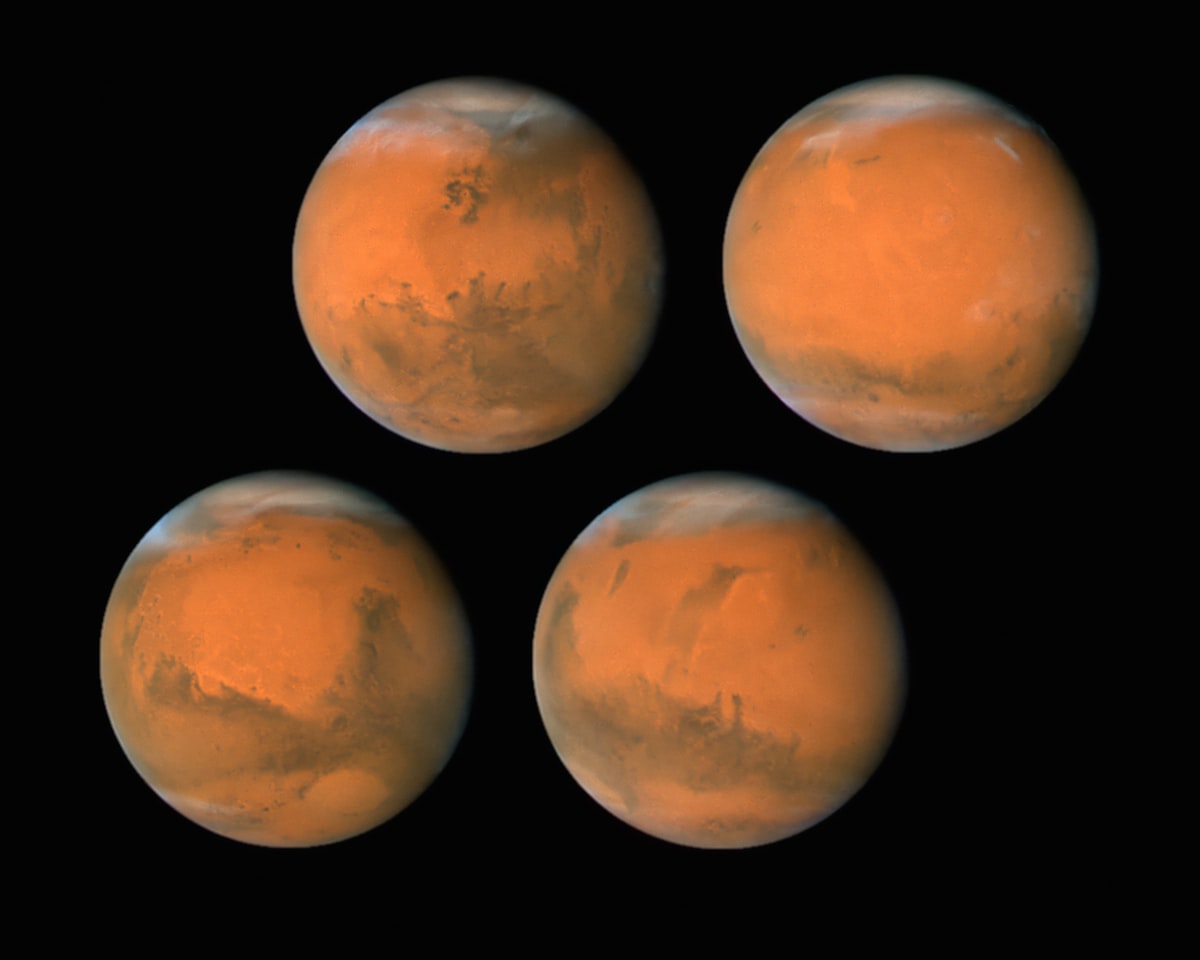
Mars follows a highly eccentric path around the Sun. But when it reaches perihelion,the point in its orbit closest to the Sun,the solar quadrupole tide stretches the surrounding space more intensely, and this phenomenon requires continuous point-calculations to prevent navigation errors for ground-based rovers and orbiting satellites. It's tricky. If a spacecraft passes near Phobos or Deimos, the small gravitational pull of these Martian moons must also be factored into the equations, so we can't ignore their influence.
The massive Martian weather cycle
Weather is the wild card. Mars undergoes a massive carbon dioxide cycle where CO2 freezes onto the polar ice caps during the winter and then sublimates back into the atmosphere during the summer. So this seasonal migration of vast gas masses physically alters the gravity field of the planet. That shift changes how time passes in different regions. It's a strange loop.
The limits of sub-picosecond accuracy
Our grasp of massive seasonal gas shifts on Mars is limited. That's why building a perfectly stable, sub-picosecond timing array there is currently impossible, but creating a flawless array wasn't the primary goal of the newly proposed framework, which instead outlines the necessary choices and supplies the mathematical workflows needed to construct a functional Mars Time Ephemeris. So it's a different aim entirely.
"By anchoring the timekeeping on Mars within the IAU's Barycentric Celestial Reference System / Barycentric Coordinate Time (BCRS/TCB) formalism.. this new paper established a mathematical pipeline from an astronaut’s wristwatch on Mars all the way back to the Solar System’s center."
Don't wait for failure. Developing these mathematical pipelines now is far better than waiting for a critical system failure to occur, since a future mismatch in the synchronization of orbital and ground assets could lead to catastrophic navigation errors. Explaining that to mission funders? It's incredibly difficult. So Areocentric Coordinate Time provides the groundwork to prevent those errors before the first colonists arrive.
Frequently Asked Questions
What is Areocentric Coordinate Time?
Areocentric Coordinate Time (TCA) is a standardized timekeeping framework for Mars, designed to account for relativistic effects like gravity and velocity that cause clocks to run differently on the Red Planet. It establishes a mathematical connection from a wristwatch on the Martian surface to the barycenter of the solar system, anchored within the BCRS/TCB formalism.
Why is Areocentric Coordinate Time needed for Mars missions?
A clock on Mars runs slightly faster than one on Earth due to Mars's shallower gravity well, and timekeeping on Mars is highly variable because of gravity and velocity effects. A standardized coordinate system like TCA is required to keep space missions synchronized and prevent catastrophic navigation errors from time mismatches.
How does Mars's weather affect timekeeping under the new framework?
Mars undergoes a massive carbon dioxide cycle where CO2 freezes onto polar ice caps in winter and sublimates into the atmosphere in summer, which physically alters the planet's gravity field. This seasonal migration of gas masses changes how time passes in different regions, requiring continuous calculations.
Who introduced the mathematical framework for Areocentric Coordinate Time?
Dr. Slava Turyshev, a researcher at NASA Jet Propulsion Laboratory, introduced the new mathematical framework. His design set a high bar for precision, ignoring only physical effects that alter a clock by less than 5x10^-18.
What practical threshold of precision does the Areocentric Coordinate Time framework aim for?
The framework ignores only physical effects that alter a clock by less than 5x10^-18, which equates to an accumulated error of 0.1 picosecond (the time light travels 0.03 millimeters). This sub-picosecond accuracy is not currently achievable for a timing array on Mars, but the framework provides the mathematical workflows needed.

Leo Sokolov reports on spaceflight and the companies and agencies racing to reach orbit and beyond. He is captivated by the engineering that makes leaving Earth possible.
💬 Comments (0)
No comments yet. Be the first!