New Catalog of 2,884 Supernovae Challenges Dark Energy Theory
A new supernova catalog of 2,884 Type 1a supernovae challenges the idea of constant dark energy, hinting it may change over time.
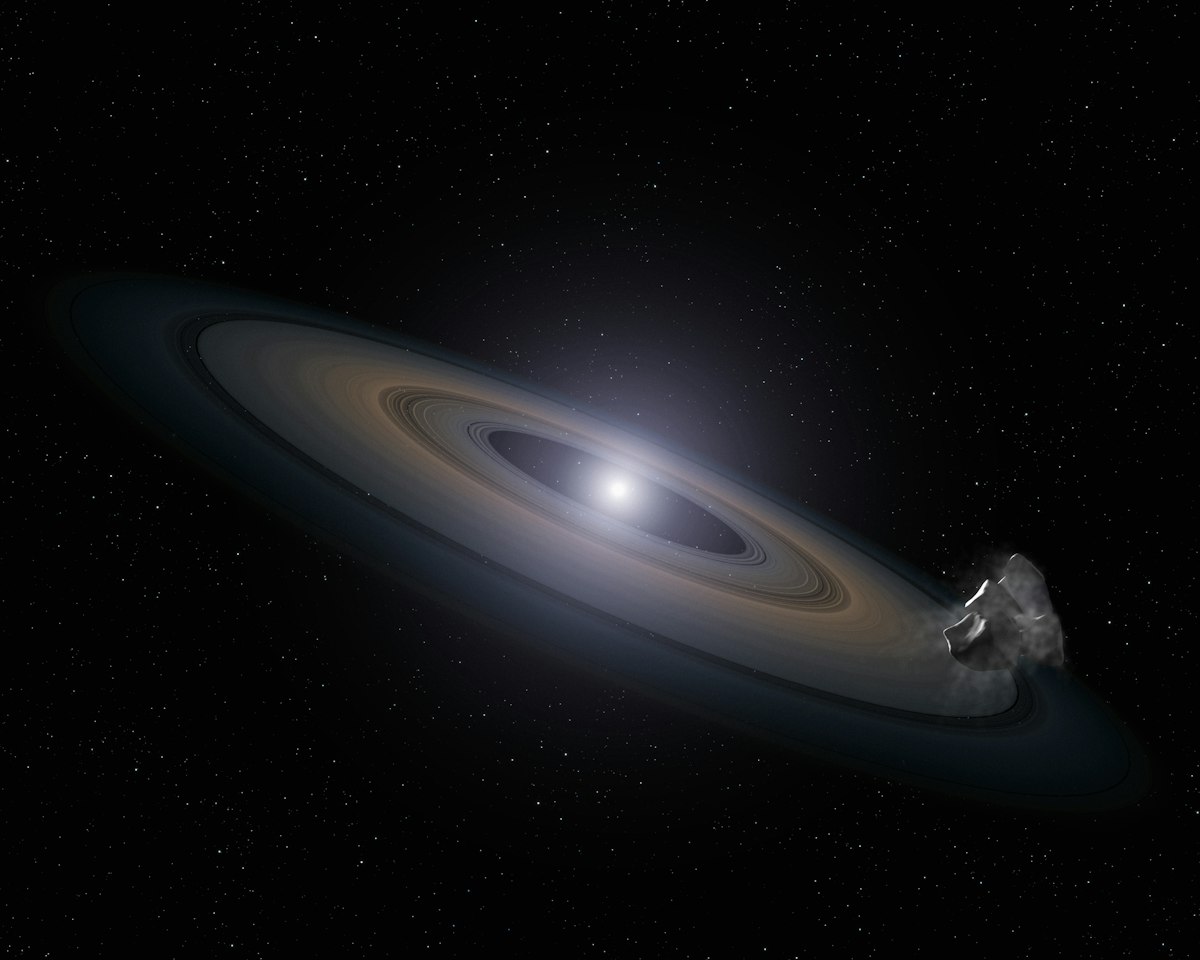
Supernova data changed everything. Three decades of it. An international team led by researchers at the University of Queensland's School of Mathematics and Physics has assembled the largest dataset of its kind, covering 2,884 Type 1a supernovae, and the results suggest that dark energy may not be the constant, unchanging force that the standard model of cosmology has long assumed. But it's upended one of the steadiest assumptions in modern cosmology. They're not so sure anymore. We've assumed too much.
A Rare Explosion, Used as a Ruler
Type 1a supernovae are uncommon events. A given one occurs roughly once every 500 years. They happen in binary systems, either when a white dwarf pulls too much material off a stellar companion or when two white dwarfs merge and cross the mass threshold that triggers detonation. That rarity is exactly why they matter so much to astronomers. These explosions are among the most energetic events in the universe, and their consistent brightness makes them reliable markers for measuring cosmic distances.
Distance measurements are the foundation. If you can pin down how far away these explosions are, you can start to reconstruct how the universe has expanded over billions of years, tracing a history that stretches across nearly all of cosmic time. That's how researchers probe dark energy. It's the mysterious force they're believed to be driving cosmic expansion.
Rebuilding Thirty Years of Observations
Ryan Camilleri, a Ph.D. Candidate at UQ-SMP, led the international effort, which drew in researchers from the United States, the United Kingdom, Australia, South Africa, Spain, and France. The work combined three decades of historical measurements with data from the Dark Energy Survey published in 2024, along with other cosmological datasets.
We've rebuilt 3 decades of astronomical observations into a single, consistent framework, Camilleri said. It's one framework. We combined our data with other cosmic measurements, including relic light from the Big Bang and maps of how galaxies are distributed through space, and that mix of our own work with these other cosmic measurements, drawn from the earliest light in the universe and from charts of where galaxies sit across space, is what we've put together. And they're all part of it.
Stacking numbers wasn't enough. The team reanalyzed older supernova observations using modern techniques, applying what astronomers have since learned about how these explosions actually behave, and that knowledge changed how they read the old data. They also worked hard to connect what different telescopes see, pulling together observations made across the full range of wavelengths. But that's not easy. The resulting compilation accounts for factors that can distort light from supernovae, including cosmic dust and gravitational lensing, which astronomers can't ignore if they're trying to get the picture right.
"We also incorporated more subtle effects such as gravitational lensing, which is the bending and magnification of light around large objects as it travels from a supernova to Earth."
The Constant That Might Not Be Constant
For decades, the Lambda parameter has been treated as a fixed quantity. It represents the Hubble-Lemaître Constant. This constant steadily pushes the large-scale structure of the universe apart, and for a long time, that's how scientists understood it. Over the past four billion years, that expansion has accelerated as galaxies drift farther apart and feel less of each other's gravitational pull. But things change. The Lambda Cold Dark Matter model, or ΔCDM, was built on the assumption that this dark energy does not change, and that assumption has shaped how we've explained the universe's expansion for a very long time.
The new supernova catalog points elsewhere. It's not confirming the standard model. Instead, the data adds weight to the possibility that dark energy varies over time, a claim that challenges what we've assumed and suggests they're seeing something the old framework can't explain.
"Instead of confirming the standard model of cosmology, which assumes dark energy is fixed and unchanging, we have more evidence that dark energy may change over time," Camilleri said.
Independent Measurements Point the Same Way
This isn't isolated. New data from the James Webb Space Telescope and fresh findings from the Dark Energy Spectroscopic Instrument have both hinted at variations in dark energy, and they're pointing in a direction that's got cosmologists paying very close attention. But they don't agree on everything. DESI reached that conclusion through surveys of relic sound waves from the early universe, a completely different line of evidence from supernova distance measurements, and that difference matters. So we've got two paths to the same suspicion.
Professor Tamara Davis, an astrophysicist, framed the result carefully. "Our supernova data from DES in 2024 first showed hints that dark energy may be time-varying, and this new compilation also sees a deviation from the standard model, although in a slightly different direction," she said.
Important. A slight difference in direction between datasets is not a trivial detail. It means the deviation is not yet pinned down cleanly, and multiple independent measurements finding evidence of variation does not automatically mean they agree on what that variation looks like.
What Comes Next
The stakes extend beyond dark energy itself. Davis noted that this line of research may hold a clue to one of the deepest unsolved problems in physics: how gravity and quantum mechanics fit together.
"We know these 2 theories are each immensely successful in their own realms, so if we can figure out how to put them together, that would be a huge step in theoretical physics," she said.
The research paper appeared in the Publications of the Astronomical Society of Australia. A corresponding paper covering host galaxy mass measurements was published separately. For now, the supernova catalog stands as the largest of its kind, and it's doing what the best datasets do, which means it's making the standard model harder to defend without offering a finished replacement.
Frequently Asked Questions
How many Type 1a supernovae are included in the new supernova catalog, and who led the effort to assemble it?
The new supernova catalog covers 2,884 Type 1a supernovae. It was assembled by an international team led by researchers at the University of Queensland's School of Mathematics and Physics, with Ryan Camilleri, a Ph.D. Candidate at UQ-SMP, leading the international effort.
Why are Type 1a supernovae considered reliable markers for measuring cosmic distances?
Type 1a supernovae are uncommon events, occurring roughly once every 500 years, but their consistent brightness makes them reliable markers for measuring cosmic distances. These explosions are among the most energetic events in the universe, and that consistency allows astronomers to use them to reconstruct how the universe has expanded over billions of years.
What does the new supernova catalog suggest about dark energy, and how does this challenge the standard model of cosmology?
The new supernova catalog adds weight to the possibility that dark energy varies over time, rather than being the constant, unchanging force assumed by the standard model. This challenges the Lambda Cold Dark Matter model, which was built on the assumption that dark energy does not change, and suggests the old framework cannot explain what the data shows.
How did the research team rebuild three decades of astronomical observations into a single framework?
The team combined three decades of historical measurements with data from the Dark Energy Survey published in 2024, along with other cosmological datasets, including relic light from the Big Bang and maps of galaxy distribution. They reanalyzed older supernova observations using modern techniques and connected observations across the full range of wavelengths, while accounting for distorting factors such as cosmic dust and gravitational lensing.
What independent measurements also point toward variations in dark energy, and what does their slight disagreement indicate?
New data from the James Webb Space Telescope and fresh findings from the Dark Energy Spectroscopic Instrument have both hinted at variations in dark energy. However, a slight difference in direction between datasets means the deviation is not yet pinned down cleanly, and multiple independent measurements finding evidence of variation does not automatically mean they agree on what that variation looks like.

Astrid Berg covers space and astronomy, from missions and launches to the science of the universe. She follows the ongoing effort to explore beyond our planet.
💬 Comments (0)
No comments yet. Be the first!