Webb Observes Extreme Debris Disks in Rare Star Systems
Using the James Webb Space Telescope, astronomers have examined young star systems experiencing cataclysmic events, offering a window into the early Solar System.
Webb Observes Extreme Debris Disks in Rare Star Systems
Webb observes extreme debris disks. It's an unprecedented look. These rare cosmic phenomena were once theorized but poorly understood, and now the James Webb Space Telescope is scrutinizing them, providing astronomers with vital clues about how worlds like our own may have come into being billions of years ago. That's the chaotic early stage of planetary system formation. And we've never seen it like this before.
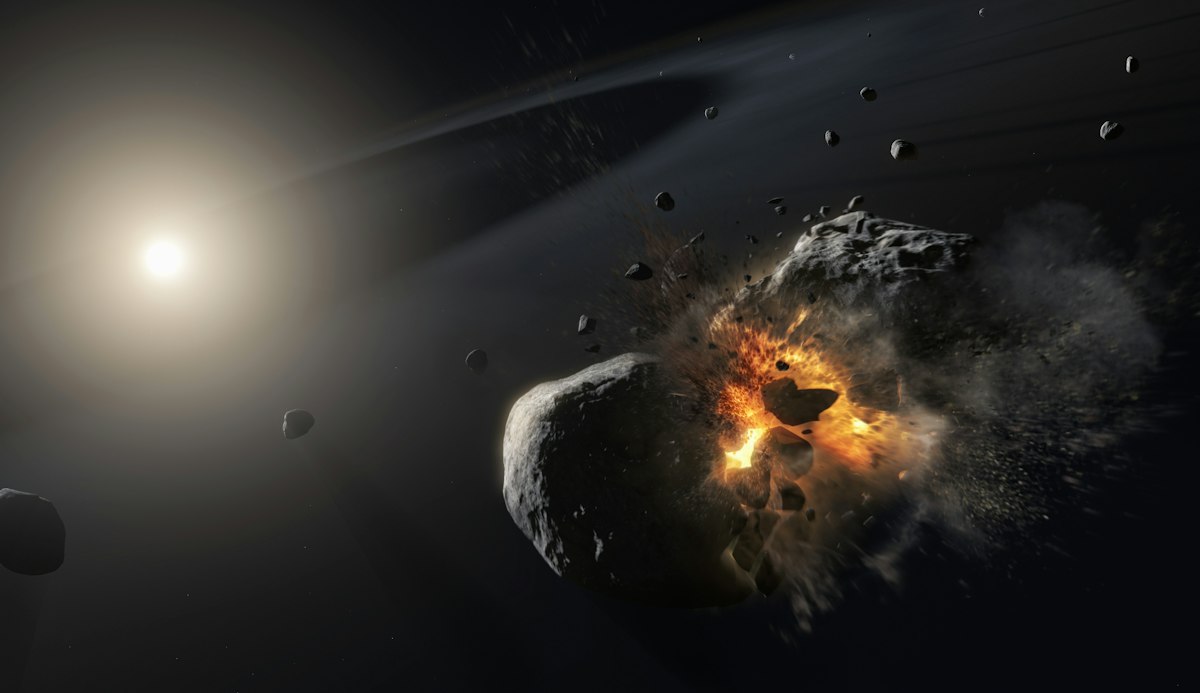
The Solar System's early days were violent. It's the prevailing scientific narrative. Planets moved. Countless smaller bodies were violently dislodged, and because of that, high-energy collisions happened frequently. And this era is famously characterized by the Giant Impact Hypothesis, which posits that a Mars-sized object, dubbed Theia, collided with the proto-Earth approximately 4.5 billion years ago, ultimately forming our Moon and shaping our planet. We've got the Moon from it.
Astronomers are using Webb now. They're peering into young star systems that appear to be undergoing similarly cataclysmic events, the kind of violent upheavals that reshape everything around them. These celestial nurseries are shedding light on the composition and evolution of nascent planetary systems, acting as cosmic time capsules that reveal the conditions of our own Solar System's infancy. It's a window back in time. And we've got questions about our own origins. These nurseries don't just show us distant worlds. They're showing us ourselves.
A Glimpse into Planetary Genesis
Star systems undergo a distinct evolutionary path. They begin as gas-rich protoplanetary disks, the ideal environment for planets to coalesce. As they age, they transition into gas-poor debris disks. Within this latter phase, NASA's Spitzer Space Telescope identified a particularly dynamic period: the extreme debris disk phase. These are environments brimming with warm dust, situated in regions analogous to where rocky planets orbit within our Solar System.
The team behind the recent Webb observations investigated systems in this extreme debris disk phase. But the results surprised them. These systems proved far less common than theoretical models predicted, and current data indicates that only about 1% of young stars exhibit these observable signatures, a figure that challenges what researchers expected to find. They're rare. Despite that rarity, the researchers managed to compile a sample of 21 such disks, drawing from both Spitzer and Webb archival data, alongside 12 newly observed disks and follow-up observations on four previously identified by Spitzer.
Webb Observes Extreme Debris Disks in Rare Star Systems
Webb observes extreme debris disks at a scale no earlier telescope could match, and that sharp view is what let researchers sort the sample so cleanly. The sample revealed something big. Eight disks were silica-rich. In the data, they're black dots. Thirteen others were silica-poor, and they're marked in purple, which makes the whole set easy to sort at a glance. Scientists think the silica-rich disks come from high-energy impacts between Mars-sized bodies, a process that vaporizes much of the material and leaves behind that strange signature. But the silica-poor disks tell a different story. They suggest collisions that were less energetic. That likely means smaller bodies. Some may have been closer in size to our Moon.

An intriguing temporal pattern emerged. Silica-rich disks were found only around stars younger than 300 million years. But silica-poor disks showed up around stars across a much broader age range. This observation aligns with simulations suggesting that rocky planets, like Earth, tend to form within the first few hundred million years of a solar system's existence. It also complements the estimated timeline for the Earth-Moon system's formation. That happened about 100 million years after the Sun's birth. It's thought to have come from a monumental collision.
"How rocky planets formed and giant planets evolved are part of the broader story of the solar system’s formation. It’s all one story," said Kate Su, a researcher and lead author of the study. "Our work on extreme debris disks helps us bring together the big picture of what we currently understand."
The findings also suggest our own Sun might have passed through a silica-poor extreme disk phase billions of years ago. That's a big claim. This possibility resonates with the Late Heavy Bombardment theory, which postulates that older, silica-poor disks and their fluctuating infrared signals could be indicative of orbital instabilities. And in such a scenario, the migration of gas giants would have disturbed the orbits of smaller celestial bodies, triggering the kind of catastrophic collisions that generate the dust-rich phases observed in these extreme debris disks.
What Comes Next for the Research
Many questions remain. They're still open. But the scientific community expects more answers about these cosmic events, because the sample of observed extreme debris disks keeps growing, and that growing sample should shed further light on what these events really are. Future research will benefit from ongoing Webb observations. It'll also benefit from upcoming missions. Those include the Nancy Grace Roman Space Telescope and the PRIMA mission. We've got more to learn, and we can't get there without more data, so the work continues as the sample expands and as new missions come online to help scientists understand these extreme debris disks in greater detail than ever before.
- The research team compiled a sample of 21 extreme debris disks.
- Of these, eight disks were silica-rich, and thirteen were silica-poor.
- Silica-rich disks were found only around stars younger than 300 million years.
- Spitzer Space Telescope initially identified the extreme debris disk phase.
This investigation isn't just cataloging rare celestial events. It's about piecing together the grand narrative of planetary formation and evolution across the cosmos. Webb observes extreme debris disks. And that lets scientists refine our understanding of the conditions that led to our own Solar System, conditions we can't observe directly but can infer from these distant, fleeting, and often violent collisions that echo the very processes that once shaped the world we've come to call home.
Frequently Asked Questions
What are extreme debris disks and how did they come to be identified?
Extreme debris disks are environments brimming with warm dust, situated in regions analogous to where rocky planets orbit within our Solar System. They were identified by NASA's Spitzer Space Telescope as a particularly dynamic period within the gas-poor debris disk phase of star system evolution.
Why are extreme debris disks considered rare, and what did the Webb observations reveal about their frequency?
Extreme debris disks are rare because they proved far less common than theoretical models predicted, with current data indicating that only about 1% of young stars exhibit these observable signatures. The Webb observations, which investigated systems in this phase, surprised researchers by showing this low frequency, challenging what they expected to find.
How do scientists distinguish between silica-rich and silica-poor extreme debris disks, and what do these differences suggest about their origins?
Scientists distinguish them based on their composition: in the data, silica-rich disks are marked as black dots, while silica-poor disks are marked in purple. Silica-rich disks are thought to come from high-energy impacts between Mars-sized bodies that vaporize material, whereas silica-poor disks suggest less energetic collisions, likely involving smaller bodies closer in size to our Moon.
When do silica-rich and silica-poor extreme debris disks appear around stars, and how does this timing relate to rocky planet formation?
Silica-rich disks were found only around stars younger than 300 million years, while silica-poor disks showed up around stars across a much broader age range. This temporal pattern aligns with simulations suggesting that rocky planets, like Earth, tend to form within the first few hundred million years of a solar system's existence.
Who conducted the recent study on extreme debris disks using Webb observations, and what did they conclude about the broader picture of solar system formation?
The study was led by Kate Su, a researcher and lead author, whose team compiled a sample of 21 extreme debris disks from Spitzer and Webb archival data, including 12 newly observed disks and follow-up observations on four previously identified by Spitzer. Su stated that their work on extreme debris disks helps bring together the big picture of what we currently understand about how rocky planets formed and giant planets evolved as part of the broader story of the solar system's formation.

Astrid Berg covers space and astronomy, from missions and launches to the science of the universe. She follows the ongoing effort to explore beyond our planet.
💬 Comments (0)
No comments yet. Be the first!