Catching An 'Almost Total' Lunar Eclipse on August 28th
Next week's deep partial lunar eclipse favors the Americas, with the Moon 93% immersed in Earth's shadow. Here's what to watch for.
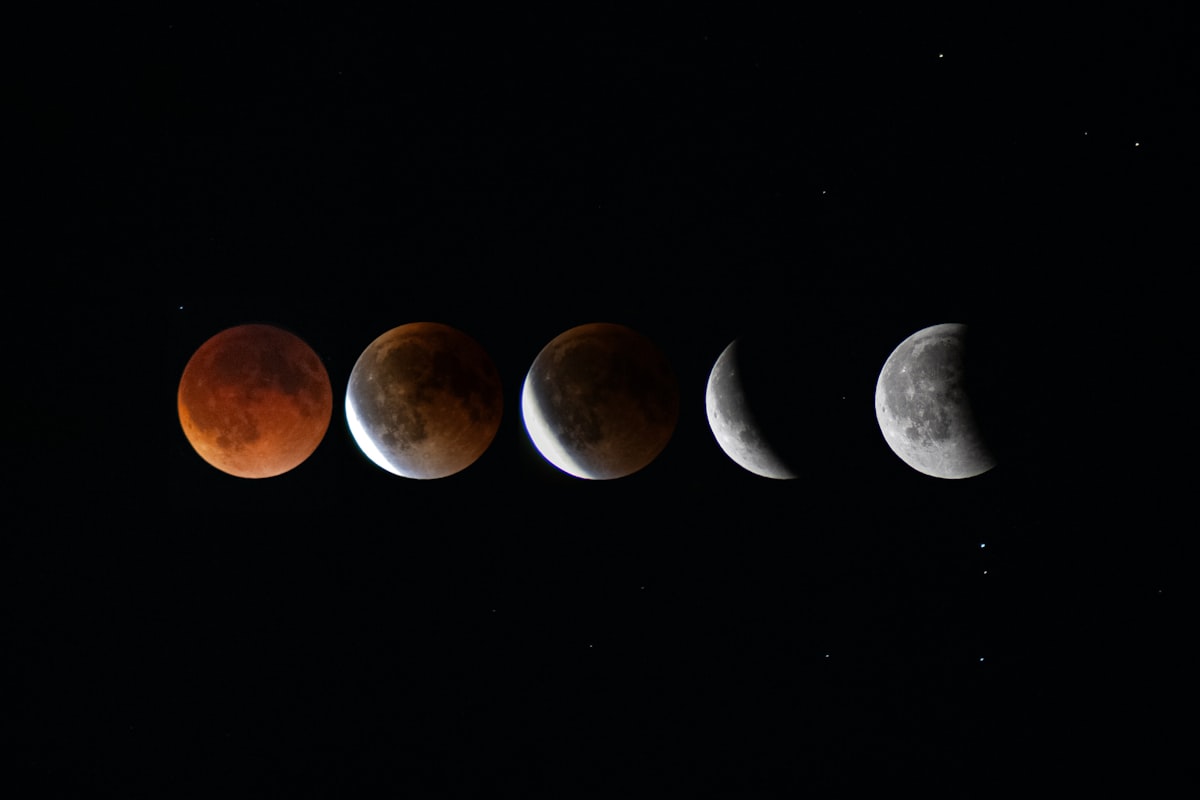
Mark your calendars for August 28th. An almost total lunar eclipse will grace the skies, and the Americas are perfectly positioned for the entire show, catching every phase from start to finish without a single interruption. It's the last eclipse of four for 2026, two lunar and two solar, so it marks the current end of the second eclipse season that began with the total solar eclipse on August 12th. But don't blink. This deep partial eclipse closes the year's celestial run.
Why This Eclipse Is Different
Eclipses happen when the Moon, Earth and Sun line up in what's known as a syzygy. The Moon's orbit tilts just over five degrees against the ecliptic plane, so the action only occurs at the nodes where those two paths cross. This time, the Moon passes its ascending node less than ten hours before reaching full phase, sending it through the northern half of Earth's umbral shadow. It won't get fully immersed, but it will come close.
Timing plays a role here. The event occurs just six days after the second-most distant lunar apogee of the year, so the Moon appears slightly smaller than usual. That matters because Earth's umbral shadow is about three times larger in diameter than the Moon. A smaller Moon means a deeper partial eclipse, and observers will see 93% of the lunar disk swallowed by darkness at maximum.
When and Where to Watch
The whole event, penumbral phases included, runs just under five hours and 38 minutes. It's a long night. It starts at 1:23 Universal Time on August 28th, which translates to 9:23 PM EDT on the 27th for viewers in North America, so you can catch it without staying up too terribly late. Partial phases begin just before 2:34 UT, or 10:34 PM EDT, and they stretch on for more than 3 hours and 18 minutes. And the maximum partial eclipse hits at 4:14 UT, which is 12:14 AM EDT. That's the peak. Don't miss it.
The Americas get the full show. It's a total eclipse, and visibility there is perfect from start to finish. Europe and Africa, though, they'll only catch the tail end as the Moon sets early on August 28th, so their view gets cut short just as things get interesting. And for the Central Pacific, the eclipse is already underway at moonrise on the evening of August 27th, meaning they're joining a party that's long since started. So plan accordingly.
What You'll Actually See
About 30 minutes into the penumbral phase, something will look off. It's subtle, but you can't miss it. The Moon takes on a slight tea-colored cast, a shift that builds so slowly you'd swear it isn't moving at all, until suddenly you realize the light has changed in a way your eyes didn't register at first.
The dark curve of Earth sweeps across the lunar surface. Its shadow proves our planet is round. And even though it's only a partial eclipse this time around, you still might see the lower southern limb of the Moon turn blood red, a sight that's unmistakable to anyone who has ever witnessed a total lunar eclipse before. That red hue is the hallmark of totality. It's caused by a hundred sunsets filtered through Earth's atmosphere and cast onto the Moon.
Watch for a subtle bluish ozone fringe near the edge of Earth's shadow. It's a rare sight. But here's the secret: an eclipse is the one time the bone white Moon comes alive with color, and you can't miss that transformation if you're paying attention.
An eclipse is the one time that the bone white Moon comes alive with color.
Capturing the Moment
Imaging is straightforward. Track and focus the Moon, then aim a handheld smartphone camera through a telescope eyepiece. With a little practice and patience, you'll get decent shots. Or just sit back and enjoy the show.
Unlike the frenzied minutes of solar totality, lunar eclipses are slow and leisurely affairs.
A Rare Saros and an Almost Tetrad
This eclipse marks the final partial eclipse for lunar saros series 138, a cycle that started in 1521 and runs all the way to 2982. It's a long goodbye. But the first total eclipse for this series won't happen until September 7th, 2044, and even then, totality will last just 34 minutes, a fleeting moment in the grand sweep of celestial time. Compare that to the shortest totality of the current century, which fell on April 4th, 2015. That one lasted a mere 4 minutes. So we've got a long wait ahead.
A full tetrad last occurred in 2014/2015
Views From Space
From Earth, we watch and wait. But an observer on most of the Moon's Earthward face would see a total solar eclipse, a spectacle that plays out in eerie silence against the barren, dust-covered horizon. Firefly Aerospace's Blue Ghost lander witnessed exactly that strange scene on March 14th, 2025, from the lunar surface, capturing what we can't see from home. South Korea's Danuri orbiter also captured a unique view of the August 12th total solar eclipse from lunar orbit, showing the Moon's shadow skimming Earth's upper right. It's a rare perspective. We've only just begun to see it.
The Virtual Telescope Project plans to carry the eclipse live starting at 1:30 UT on the 28th. That's the setup for something bigger. So don't miss this one, because it serves as a direct lead-up to the next total lunar eclipse on December 31st, 2028, which promises to be a spectacular celestial event worth marking on your calendar right now. It's a rare treat. And we can't wait.
Frequently Asked Questions
What makes the lunar eclipse on August 28th an 'almost total' eclipse?
The eclipse is described as 'almost total' because the Moon passes through the northern half of Earth's umbral shadow but does not get fully immersed. At maximum, observers will see 93% of the lunar disk swallowed by darkness, leaving a small portion uncovered.
Why does the Moon appear slightly smaller during this eclipse, and how does that affect the eclipse's depth?
The event occurs just six days after the second-most distant lunar apogee of the year, so the Moon appears slightly smaller than usual. Because Earth's umbral shadow is about three times larger in diameter than the Moon, a smaller Moon results in a deeper partial eclipse, with 93% coverage at maximum.
When and where can observers in the Americas watch the entire eclipse without interruption?
The Americas are perfectly positioned for the entire show, catching every phase from start to finish without a single interruption. The eclipse starts at 1:23 UT on August 28th, which is 9:23 PM EDT on the 27th for North American viewers, and the maximum partial eclipse hits at 4:14 UT, or 12:14 AM EDT.
What visual cues indicate that the penumbral phase is underway and the partial phases are about to begin?
About 30 minutes into the penumbral phase, the Moon takes on a slight tea-colored cast, a subtle shift that builds slowly. Then the scraggy charcoal edge of Earth's inner shadow appears, serving as a harbinger of the partial phases about to begin, signaling that the darkness is becoming a creeping, deliberate force.
How is this eclipse connected to future lunar eclipses, and what does the article say about its saros series?
This eclipse marks the final partial eclipse for lunar saros series 138, a cycle that started in 1521 and runs to 2982. It serves as a direct lead-up to the next total lunar eclipse on December 31st, 2028, which is promised to be a spectacular celestial event.

Astrid Berg covers space and astronomy, from missions and launches to the science of the universe. She follows the ongoing effort to explore beyond our planet.
💬 Comments (0)
No comments yet. Be the first!