Astronomy's Quest to Understand Cosmic Topology
Cosmic topology could reveal whether the universe loops back on itself, and astronomers are hunting its signatures in the CMB and galaxy maps.
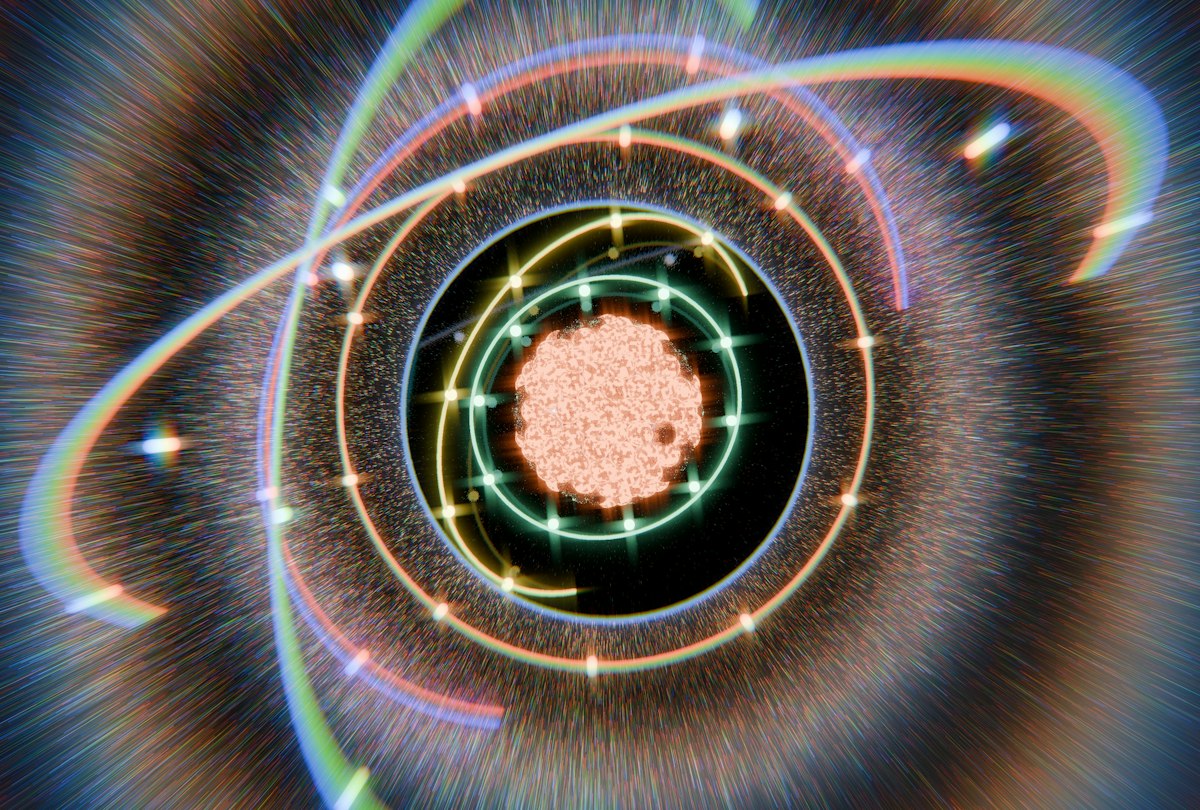
Cosmic topology is the study of the global shape and connectivity of the universe, and it asks a question that sounds almost philosophical: if you traveled far enough in one direction, could you eventually come back to where you started? For decades, astrophysicists have been chasing that possibility through observations of the oldest light in existence. The answer could upend the standard assumption that we live in a flat, infinite cosmos stretching forever in every direction.
A Universe That Loops Back
If some aspects of cosmic topology turn out to be true, the idea that starships might voyage the cosmos over hundreds of thousands of light years without ever returning to the same neck of space-time could be problematic. That is because the global shape of the universe could dictate a closed loop on the largest scales. In some instances, a starship heading in one direction for long enough could hypothetically return to its starting point.
Andrew Jaffe, professor of cosmology and astrophysics at Imperial College London, explains that in some cases there is an actual physical and straight path that can take you back to where you started, but not to when you started. If it took you back to the original time and spatial point, you would have something called a closed timeline curve. A time machine, in other words.
"Our work with COMPACT has started to put these results into the full mathematical theory and details of the possible topologies that could describe our Universe."
We live in a flat cosmos. That's the current paradigm, and it says this cosmos is infinite in all directions, though global topology may ultimately invalidate part, or all, of that axiom. Topology is characterized by the possible existence and properties of unshrinkable closed loops. So if you could travel far enough in some direction along the loop, you'd return to your starting point. We've got no guarantee it's that simple.
Reading the Oldest Light
Cosmic topology would imprint subtle signatures on the cosmic microwave background and on the three-dimensional distribution of matter. And that could break homogeneity at the largest scales. The CMB is the furthest back in cosmic time that is currently observable. It's the light that last interacted with matter, some 380,000 years after the Big Bang, and because it's the oldest signal we've got, it carries whatever imprint the universe's shape left behind, if the universe's shape left one at all.
Cosmologists have been observing the CMB since the 1960s, but only since the early 2000s have they had enough sensitivity to detect the patterns that would enable them to see topology. The modern era of cosmic topology started in the late 1990s, when researchers realized they could use patterns in the CMB to look for topology. Great strides followed with data from the WMAP satellite in the mid-2000s and then with yet higher-quality data in the 2010s. The data has not improved much since then.
In the last few years, Jaffe and colleagues have created a group called COMPACT. It's the Collaboration for Observations, Models and Predictions of Anomalies and Cosmic Topology. Twenty scientists. They're international. And they're dedicated to thinking about this topological problem, which, when you consider how much work it takes to coordinate researchers across so many time zones and institutions and specialties, isn't a small commitment.
What a Signature Would Look Like
A true three-dimensional map of the observational cosmos would go a long way in identifying cosmic topology, beyond just studying anomalies on the surface of the cosmic microwave background. That's the gas, galaxies, and clusters of galaxies. They're what astronomers can observe with the best telescopes. And a proper three-dimensional map of that matter, the kind that captures everything we can see with the finest instruments we've built, would give us even more information about the topology of the universe, possibly all the information that we could ever have.
The goal is to try to see those repeating patterns, by looking at as much of the universe as possible. As for what would be a telltale signature? The existence of such identifications means that two areas of the sky that seem to be far apart might in fact be close together. In the simplest case, this gives us repeated patterns. For the CMB, it might mean that there is a circle on one side of the sky that has exactly the same pattern as a circle far away from it.
Jaffe uses the analogy of a three-dimensional torus. It's a geometric shape. It resembles a ring or a doughnut. Now imagine a circle that goes around the tube of a donut that would cut through the tube, and that simple mental picture is exactly what Jaffe wants you to hold onto as you follow the rest of his reasoning about shape and space. The existence of paths like this indicates the kind of topology researchers are looking for.
Twin Galaxy Clusters
There might even be signatures of topology in galaxy clusters that mirror each other from halfway across the cosmos. But such phenomena will be difficult to observe. We know the scale of the topology, if it's something like a torus, must be large enough that we can't observe those twins. They're too far apart. Too far from us. We can't see both at once. And even if we can eventually observe the cosmos on such large scales, this type of topological phenomena may forever be out of our reach.
Why the Size Question Matters
We may also be fortunate. The evidence for cosmic topology may be sitting in existing data. Or it may be collected over the coming years in campaigns to observe the CMB, to map the distribution and velocities of galaxies and other tracers of large-scale structure, work that's already underway and that we've come to rely on. So it's possible we don't need to wait at all. And they're already looking.
The bottom line comes down to a single unknown. We need to know the universe's size. If it is too big, much larger than the distance to the CMB sphere, we will not be able to detect it. That is the quiet trap hidden inside the search. The very scale that would make cosmic topology real could also make it invisible.
For now, the quest continues on two fronts. One is mathematical. COMPACT works through the full theory of possible topologies. The other is observational, as astronomers push telescopes to map matter across ever greater volumes, extending their reach into regions of space so vast that no single instrument could ever capture them alone. And somewhere in the data, or in the math, the answer may already be waiting. It's out there. We've just got to find it.
- Cosmic topology examines the global shape and connectivity of the universe.
- Closed loops could allow a traveler to return to a starting point, but not the starting time.
- The CMB and the three-dimensional distribution of matter carry potential topological signatures.
- Repeated patterns on opposite sides of the sky could reveal hidden connections.
The Long Wait for Better Data
Progress has been uneven. The WMAP era delivered a leap, and the 2010s brought sharper data still. Since then, the observational picture has largely stalled, and that stalling is part of why the theoretical work has taken on new weight, because when you don't get fresh data coming in to test your ideas against, the math has to do more of the heavy lifting. But it's stalled. We've got no new observations. And the math has to do more of the heavy lifting.
Whether the universe loops back on itself remains an open question. For now, the search for cosmic topology is a reminder that the largest truths about our cosmos may be hidden in the smallest patterns, waiting for someone to notice they repeat.
Frequently Asked Questions
What is cosmic topology and what central possibility does it explore?
Cosmic topology is the study of the global shape and connectivity of the universe. It asks whether traveling far enough in one direction could eventually bring you back to where you started.
Why is the cosmic microwave background so important for the search for cosmic topology?
The CMB is the furthest back in cosmic time that is currently observable, having last interacted with matter some 380,000 years after the Big Bang. Because it is the oldest signal we have, it carries whatever imprint the universe's shape left behind, if any such imprint exists.
How did the modern era of cosmic topology research begin and progress through satellite data?
The modern era started in the late 1990s, when researchers realized they could use patterns in the CMB to look for topology. Great strides followed with data from the WMAP satellite in the mid-2000s and then with yet higher-quality data in the 2010s.
What is the COMPACT collaboration and what is its purpose?
COMPACT is the Collaboration for Observations, Models and Predictions of Anomalies and Cosmic Topology, made up of twenty international scientists. They are dedicated to thinking about the topological problem and working through the full theory of possible topologies.
What does the article say about the difficulty of observing twin galaxy clusters as a topological signature?
Signatures of topology might exist in galaxy clusters that mirror each other from halfway across the cosmos, but such phenomena will be difficult to observe. If the topology is something like a torus, its scale must be large enough that we cannot observe those twins because they are too far apart and we cannot see both at once.

Astrid Berg covers space and astronomy, from missions and launches to the science of the universe. She follows the ongoing effort to explore beyond our planet.
💬 Comments (0)
No comments yet. Be the first!