Air-Breathing Plasma Engine for VLEO Satellites
A new plasma engine design could let VLEO satellites fuel on thin air, using an RF Helicon thruster and a specular intake to stay aloft.
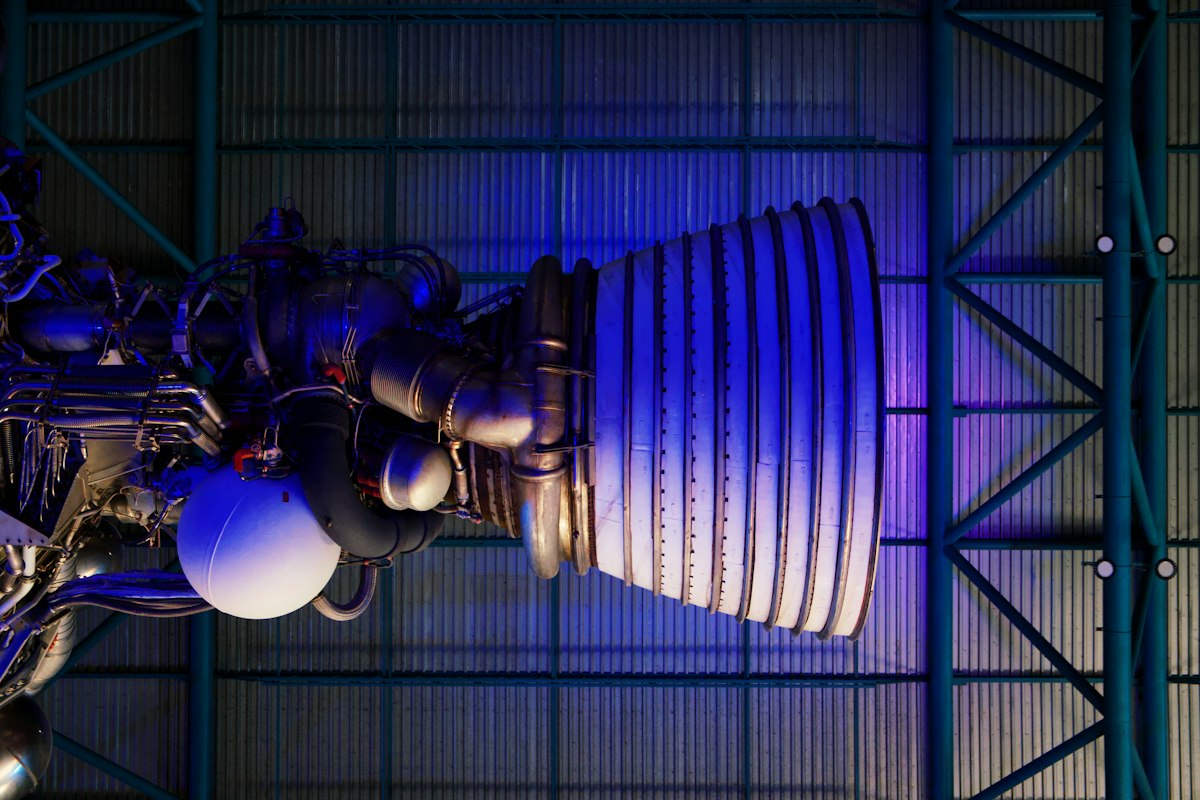
Plasma engine research has a new answer for one of the oldest problems in low orbit: running out of fuel. A doctoral thesis at the University of Stuttgart, now available on arXiv, lays out a design for an atmosphere-breathing electric propulsion system that would let satellites in Very Low Earth Orbit stay aloft indefinitely by feeding on the thin air that would otherwise drag them down.
The work belongs to Francesco Romano, who built the concept around a category of propulsion known as Atmosphere-Breathing Electric Propulsion (ABEP). The premise is elegant. Instead of carrying heavy tanks of xenon, a satellite would scoop up the sparse gas molecules in front of it, channel them into an electric engine, strip them into plasma, and fire that plasma out the back for thrust.
Simple to describe. Brutal to build.
Why VLEO Is Both Prize and Trap
Very Low Earth Orbit, the band between 100 and 450 kilometers, offers real advantages. Remote sensing cameras capture sharper images from closer in. Communications and radar hardware demands less power. Dead satellites get cleaned up automatically because atmospheric drag pulls them down and burns them up.
The catch is that same drag. Any satellite parked in VLEO has to fire its engine almost constantly just to hold altitude. That means fuel, and the fuel of choice has traditionally been expensive gases like xenon. Missions end when the tank runs dry, not when the hardware fails.
Romano's thesis treats those two facts as one problem with one solution. It's simpler than you'd think. The very molecules causing the drag become the propellant that fights it. But here's what that means when you sit with it: the thing slowing you down and the thing pushing you forward aren't two separate forces you've got to balance, they're the same force, and they're working on the same problem at the same time.
Atomic Oxygen Eats Engines Alive
The first obstacle is chemistry. In the upper atmosphere, ultraviolet radiation splits molecular oxygen into atomic oxygen, a single, aggressive form of the gas. Atomic oxygen is notoriously oxidative. It corrodes metal electrodes, acceleration grids, and the cathodes inside standard Hall thrusters and other ion engines.
That last point is the killer. The cathode sits inside what amounts to an electron gun, the component that neutralizes the spacecraft so it does not build up charge and suck its own exhaust back in. If atomic oxygen burns through the cathode, the whole ion propulsion system fails.
The second obstacle is variability. The atmosphere shifts with the day and night cycle, with latitude, and with solar activity. Building an engine that keeps running smoothly across all of those conditions has proven stubbornly difficult.
A Thruster Borrowed From an MRI Machine
Romano had two problems. He sidestepped both. He built a contactless, neutralizer-less radio-frequency Helicon plasma thruster, and he paired that thruster with a purpose-built intake, which is a lot of engineering for one person to take on, but that's exactly what he did.
He used a birdcage antenna. It's the same style of component found in MRI machines. And it fed power into the discharge, which is exactly what this part of the system needed to do. The result was that 99 percent of the delivered electrical power actually entered the thruster, a figure that stands out because it's very high and because it improves on standard wire coils, which lose some power to their own reactance.
A solenoid wrapped around the engine generates a magnetic field that pushes the plasma out the back as a quasi-neutral jet. Both positive and negative ions leave the thruster together. No separate neutralizer required, which means no cathode for atomic oxygen to destroy.
Three Intakes, One Clear Winner
The intake side went through three iterations. Romano tested an enhanced funnel design that acted as a molecular trap, capturing air particles so thinly spread they never collide with one another. He tried a diffuse intake built from a compact hexagonal design in coated titanium alloy. And he built a specular intake, a parabolic mirror coated with graphite or silicon dioxide that bounced particles straight into the engine.
The specular version won on both collection efficiency and alignment sensitivity. In wind tunnel tests using atomic oxygen, argon, or nitrogen, it captured roughly 94.3 percent of the particles. Tilt it by 15 degrees, and efficiency fell by only 8 percent.
Testing inside a vacuum chamber that simulated VLEO atmospheric concentrations of the three primary gases, the engine produced steady plasma streams on just 50 to 60 watts of radio-frequency power.
That power level sits comfortably within what ordinary spacecraft solar panels can generate.
From the Lab to Real Orbits
Validation in a chamber is one thing. Romano went further and applied models of the propulsion system to actual mission profiles. One was GOCE, the European satellite that famously flew in VLEO on a xenon ion thruster until it ran out of fuel.
His calculations suggest the new engine could operate indefinitely between 190 and 250 kilometers using under 1.6 kilowatts. Again, well within the reach of standard solar arrays.
The applications do not stop at Earth. Mars has an atmosphere dominated by carbon dioxide, and the same calculations indicate the engine could sustain a spacecraft indefinitely above the Red Planet at altitudes between 120 and 160 kilometers. That is far closer than existing orbital satellites fly.
What Comes Next Is Anyone's Guess
There's no guarantee this plasma engine ever leaves the laboratory. Plenty of clever propulsion concepts die between the vacuum chamber and the launch pad. So the design stays stuck. De-risking the design and proving it on an actual mission, which is the only way anyone would ever know if it's more than a promising idea sitting on a bench, would take years and serious money. And we've got neither to spare.
It is also unclear whether Romano himself plans to pursue that path. His doctoral work shows the design has potential. Whether someone out there picks it up and turns thin air into a permanent orbit is a different question entirely.
For now, it's a proof of concept. But atmospheric drag has long been the tax collector of Very Low Earth Orbit, and it's the kind of relentless force that quietly strips away a spacecraft's hard-won altitude, mission by mission, orbit by orbit, until nothing is left but a fiery plunge. So maybe it's not the enemy. Maybe it's the fuel supply.
Frequently Asked Questions
What is the core premise of Francesco Romano's Atmosphere-Breathing Electric Propulsion (ABEP) concept for satellites in Very Low Earth Orbit?
The concept is that a satellite would scoop up the sparse gas molecules in front of it instead of carrying heavy tanks of xenon, channel them into an electric engine, strip them into plasma, and fire that plasma out the back for thrust. This would let satellites in VLEO stay aloft indefinitely by feeding on the thin air that would otherwise drag them down.
Why does atomic oxygen pose such a severe threat to conventional ion engines in VLEO?
In the upper atmosphere, ultraviolet radiation splits molecular oxygen into atomic oxygen, which is notoriously oxidative and corrodes metal electrodes, acceleration grids, and the cathodes inside standard Hall thrusters and other ion engines. If atomic oxygen burns through the cathode, the whole ion propulsion system fails because the cathode neutralizes the spacecraft so it does not build up charge and suck its own exhaust back in.
How did Romano's radio-frequency Helicon plasma thruster avoid the need for a neutralizer, and where did the design idea come from?
He built a contactless, neutralizer-less radio-frequency Helicon plasma thruster that uses a birdcage antenna, the same style of component found in MRI machines, to feed power into the discharge. A solenoid wrapped around the engine generates a magnetic field that pushes the plasma out the back as a quasi-neutral jet, so both positive and negative ions leave together and no separate neutralizer is required, meaning no cathode for atomic oxygen to destroy.
Which intake design performed best in Romano's tests, and what were its measured collection efficiency and sensitivity to misalignment?
The specular intake, a parabolic mirror coated with graphite or silicon dioxide that bounced particles straight into the engine, won on both collection efficiency and alignment sensitivity. In wind tunnel tests using atomic oxygen, argon, or nitrogen, it captured roughly 94.3 percent of the particles, and when tilted by 15 degrees, efficiency fell by only 8 percent.
What did Romano's calculations suggest about applying his engine to real mission profiles, including at Mars?
For GOCE, the European satellite that flew in VLEO on a xenon ion thruster until it ran out of fuel, his calculations suggest the new engine could operate indefinitely between 190 and 250 kilometers using under 1.6 kilowatts. The same calculations indicate the engine could sustain a spacecraft indefinitely above Mars at altitudes between 120 and 160 kilometers, where the atmosphere is dominated by carbon dioxide.

Leo Sokolov reports on spaceflight and the companies and agencies racing to reach orbit and beyond. He is captivated by the engineering that makes leaving Earth possible.
💬 Comments (0)
No comments yet. Be the first!