Apsidal Precession Finds 27 Circumbinary Candidates
Using the apsidal precession method, astronomers have uncovered 27 new circumbinary planet candidates in TESS data, potentially revealing thousands.

Rare shortcut to hidden worlds. A team at the University of New South Wales in Sydney, Australia, used that rare shortcut from apsidal precession to identify 27 new circumbinary planet candidates, nearly tripling the known population in one sweep. Before this, they'd confirmed only about 18 such planets among more than 6,000 exoplanets and candidates. And they're from a pilot study mining data from NASA's Transiting Exoplanet Survey Satellite, TESS, which launched in 2018.
A New Way to Hunt Hidden Worlds
It's all about alignment. The dominant planet-hunting technique, the transit method, relies on perfect alignment; a planet must cross between its star and our telescope causing a tiny periodic dip in brightness. It works beautifully when the geometry cooperates. But if a planet's orbit tilts away from our line of sight, the transit never happens and the world stays invisible.
Apsidal precession sidesteps that problem entirely. Rather than watching for planetary shadows, it monitors how binary stars orbit and eclipse each other. When something is off, when the timing or character of those eclipses shifts in a measurable way, a third body is likely tugging on the system. That body could be a planet. And this is where it gets interesting.
What the Transit Method Misses
Margo Thornton's challenge was blunt. She's an astronomer and PhD candidate at UNSW who led the study. But most of what we know about exoplanets is shaped by how easy they are to find, and single-star systems like ours dominate catalogs not because they dominate galaxy but because they're simpler to search.
"We've mostly found the easiest ones to detect," Thornton said. "This new method could help us uncover a large population of hidden planets, especially those that don't line up perfectly from our line of sight."
But that framing misses something. Single-star systems are not the norm. More than half the stars in the galaxy exist in binary or multiple star systems. The transit method has been filtering out the majority of stellar environments without anyone quite realizing the scale of the blind spot. Apsidal precession changes the filter.
27 Candidates, Countless Questions
The Numbers at a Glance
27 candidates emerged from the pilot study. The worlds are a mixed bag.
- Some are super-Neptunes. Others are super-Jupiters.
- Distances range from 650 light-years out to 18,000 light-years from Earth.
- The candidates are scattered across both southern and northern skies.
- They belong to a sample of 1,590 nearby binary systems that could host planets.
He didn't see this coming. Professor Ben Montet, astronomer and senior author on the study, says he wasn't expecting to find 27 early from pilot study, but now he starts really fun project of figuring out which are real planets.
So it's fast. Thornton made these findings just one year into her PhD, and the work's fast because the method doesn't require new telescopes or new hardware, and it mines existing TESS data with a fresh analytical lens.
From Tatooine to Reality
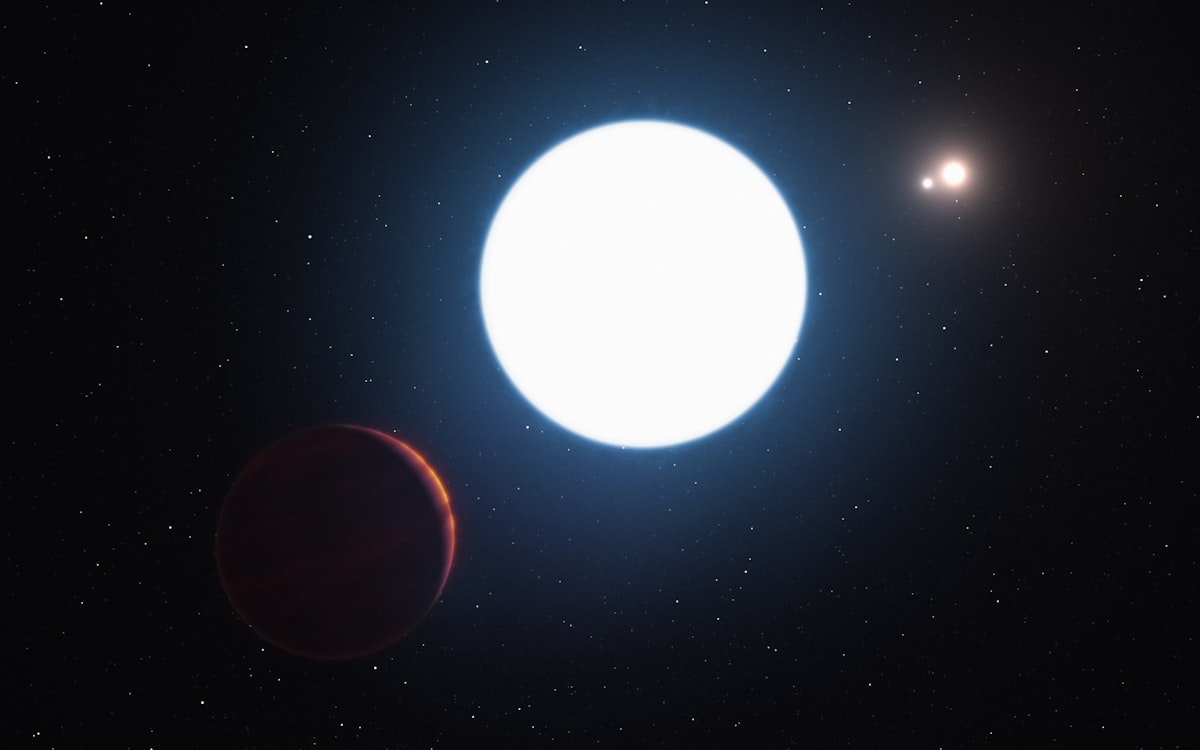
It's unavoidable. Circumbinary planets conjure images of twin suns setting over desert landscapes, the scene etched into science fiction memory by Luke Skywalker's homeworld, but the scientific stakes are far larger than cinematic nostalgia.
This method's 27 strong planet candidates. Thornton: so far, by learning more about different types of planets in environments completely unlike our own solar system, we'll better understand how planets form and evolve, especially in these complex environments with two stars.
So the architecture of these systems raises questions that go beyond formation theory. Could any harbor life? Montet doesn't shy away from the implication that "If circumbinary planets do turn out to be habitable, that means life could be anywhere," he said. "Life could be everywhere." "The sheer numbers are really exciting.
What Comes Next
The team now faces the hard work of confirmation. A candidate is not a planet, not yet. Each signal must be vetted. False positives must be ruled out. The Vera C. Rubin Observatory's Legacy Survey of Space and Time, a ten-year sky survey, stands ready to accelerate the search.
- Confirming which of the 27 candidates are real planets
- Determining formation histories and orbital evolution
- Exploring habitability potential in circumbinary environments
- Scaling the search across thousands of additional binary systems
Montet doesn't see a ceiling. He frames the 1,590 nearby binary systems as a starting point, and that implies there could potentially be thousands or tens of thousands of possible planets to be found, according to his statement. But apsidal precession has opened a door the transit method left closed. So the real population of planets in the galaxy may look nothing like the catalog we've built so far.
Frequently Asked Questions
What is apsidal precession?
Apsidal precession is the slow rotation of an orbit's major axis over time, caused by gravitational interactions.
How does apsidal precession help find circumbinary planets?
It reveals subtle orbital shifts in binary star systems, indicating the presence of unseen planets orbiting both stars.
What are circumbinary candidates?
They are potential planets that orbit two stars, detected through their gravitational influence on the binary's apsidal precession.
How many circumbinary candidates were found?
The study identified 27 new circumbinary planet candidates using apsidal precession analysis.
Why is this discovery significant?
It demonstrates a new method for detecting planets in binary systems, expanding our understanding of planet formation.

Leo Sokolov reports on spaceflight and the companies and agencies racing to reach orbit and beyond. He is captivated by the engineering that makes leaving Earth possible.
💬 Comments (0)
No comments yet. Be the first!