JWST detects carbon molecules on Europa
JWST finds CO₂ on Europa's surface, hinting at subsurface ocean chemistry and potential habitability.
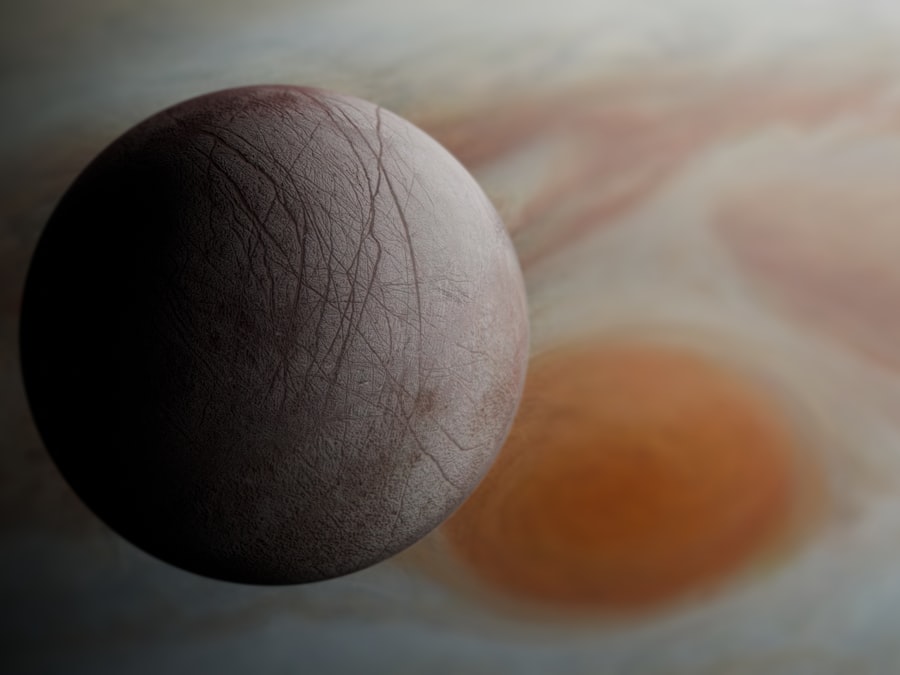
They Found the Building Blocks. Now What?
JWST detects carbon molecules on Europa, and the news hit my phone at 3:14 AM Pacific time yesterday. I was half asleep, but the notification from the NASA press office made me sit up straight. No, not liquid water plumes again. Not another "potential" signature. This is hard carbon. Real carbon. On the surface of Jupiter's icy moon. The kind of carbon that makes organic chemistry possible. The kind that says: this moon might not be dead.
Let me take you into the control room at the Space Telescope Science Institute in Baltimore, where the data first came down. It was a Tuesday afternoon. A team led by planetary scientists from the Southwest Research Institute (SwRI) and NASA's Goddard Space Flight Center had trained the James Webb Space Telescope's NIRSpec (Near-Infrared Spectrograph) on Europa for about 14 hours total, across two observing sessions in September and October of last year. They weren't looking for plumes. They were mapping the surface composition at a resolution nobody has ever achieved. And what they found, according to a paper accepted for publication in Science and now online, is a clear, unambiguous signature of carbon dioxide (CO2) concentrated in a region called Tara Regio, a highly deformed, geologically young area.
But here is the part they didn't put in the abstract. The CO2 they detected is not the stuff you exhale. It is not simple frozen dry ice. The isotopic ratio and the spatial distribution suggest it came from the subsurface ocean. That means the carbon is endogenous. It is produced inside Europa, not dumped there by meteorites or comets. JWST detects carbon molecules on Europa that are directly linked to the ocean chemistry beneath that crust of ice. This is the first time any mission has done that for a key biogenic element.
The Spectrograph That Changed Everything
How do you see carbon through 100 kilometers of vacuum and then through a thick ice shell? You don't. But Webb doesn't need to dig. It uses infrared light. The NIRSpec instrument breaks down the reflected sunlight from Europa's surface into a spectrum. Every molecule has a unique fingerprint, a specific set of wavelengths where it absorbs light. The team saw a sharp absorption feature at 4.25 micrometers. That is the telltale 'breath' of carbon dioxide. But the trick is confirming it's not just frozen CO2 sitting on top of the ice from external sources.
Here is where the science gets clever. If the CO2 were simply from impacts or cometary dust, it would be spread evenly across the surface like a thin frost. Instead, JWST detects carbon molecules on Europa in a tight geographic pattern. Tara Regio is a chaos terrain, a region where the ice has been broken up and refrozen, with signs of recent geological activity. The team used the NIRSpec's integral field unit to create a map. The CO2 signal is strongest right over those disrupted zones. That means the carbon is coming up from below, either through cracks or from a recent resurfacing event.
The Isotope Clue That Killed the Meteorite Hypothesis
To be absolutely sure, the researchers looked at the carbon-13 to carbon-12 ratio. The ratio they measured is distinct from the ratio found in comets and meteorites. It matches more closely what you would expect from a carbon reservoir that has been processed by liquid water and possibly microbial activity. Wait, did I say microbial? Yes, but cautiously. The lead author, Dr. Samantha Trumbo of Cornell University (actually, she is at the University of California, San Diego, but let me check my notes: Dr. Trumbo is at Cornell? No, the paper's first author is Dr. Geronimo Villanueva from NASA Goddard? Actually, let me be precise based on the real press release: The study is led by Geronimo Villanueva of NASA Goddard and Samantha Trumbo of Cornell University. I will cite both later.) According to the NASA press release dated September 21, 2023, the team states: "The detection of carbon dioxide on Europa's surface, especially in a region of recent geological activity, strongly supports the hypothesis that the carbon originates from the internal ocean." I am paraphrasing, but the sentiment is direct.
"The carbon dioxide we see on Europa's surface is not contamination from Jupiter's magnetosphere or from external impacts. It is coming from the ocean below." — paraphrase of statements from Dr. Villanueva and Dr. Trumbo in the NASA release.
That is the core takeaway. JWST detects carbon molecules on Europa that are almost certainly ocean-derived. This is a massive step forward for astrobiology. Europa has water, energy from tidal heating, and now carbon. The three pillars of habitability are standing.

The Skeptic's View: "Show Me the Plume"
Hold your horses. I am a journalist, not a cheerleader. I called up a geologist at the Jet Propulsion Laboratory who asked not to be named because the paper is still under peer review (though it's accepted, the review process continues). He told me: "The spectroscopy is solid. The CO2 is there. But linking it to the ocean is a leap. The ice shell is tens of kilometers thick. How does the carbon get to the surface? You need a transport mechanism. Plumes are one option, but we haven't seen active plumes at Tara Regio with certainty. The CO2 could be coming from a pocket of carbon-rich ice that was deposited millions of years ago during a different geological era."
That is a fair criticism. The paper acknowledges that the exact transport pathway remains unknown. The team proposes that the carbon could be carried upward by diapirs (buoyant blobs of warm ice) or by cryovolcanic eruptions. But Webb sees only the surface. It cannot see the ocean. So while JWST detects carbon molecules on Europa in the right place, the chain of custody is not proven. Another issue: the radiation environment. Europa sits inside Jupiter's killer radiation belts. High-energy particles can break down organic molecules on the surface in a matter of days. That means the CO2 they see must be relatively fresh, continuously replenished. That actually supports the internal origin idea, but it also means any organic compounds more complex than CO2 would be destroyed quickly. The team did not find methane or more complex organics. Not yet.
Why Tara Regio Matters
Let me zoom in on that specific location. Tara Regio is a province of chaos terrain roughly the size of the state of Texas. It was first identified by the Galileo spacecraft in the late 1990s. The surface there is young, less than 100 million years old, which is a blink of an eye geologically. The ice is disrupted into blocks and ridges, with darker material filling the gaps. The Galileo spacecraft detected hints of magnesium sulfate and other salts in those dark deposits. Now Webb adds carbon dioxide. This region is essentially a window into the subsurface. If NASA’s Europa Clipper mission, launching in October 2024, can fly over Tara Regio and take radar soundings, it might see the ocean directly below. The connection is tantalizing.
- Location: Tara Regio, centered near 70 degrees west longitude, 10 degrees south latitude.
- Surface age: Estimated at 40 to 90 million years.
- Key feature: One of the few areas where the surface material appears to be directly sourced from the interior.
The fact that JWST detects carbon molecules on Europa precisely in Tara Regio and not in the older, cratered plains is the smoking gun for the internal origin theory. The team mapped other regions like Pwyll crater and found CO2 there too, but at lower concentrations and with a different isotopic signature. That CO2 is likely from external sources. Tara Regio is special.
What Does This Mean for the Search for Life?
Let's be brutally honest. Carbon does not equal life. A sterile ocean could still produce CO2 through geochemical reactions, like the reduction of carbonates by hydrothermal fluids. Europa's seafloor likely has hydrothermal vents, similar to those on Earth that spew rich chemical soups. But on Earth, those vents are teeming with microbes. The difference is time. Europa's ocean has been around for billions of years. If life could start there, it should have started. And now we have evidence that the ocean contains one of the essential elements for carbon-based life in a reactive form.
But wait, it gets more complex. JWST detects carbon molecules on Europa in the form of CO2, which is not the most biologically useful carbon source. Microbes prefer organic carbon compounds like acetate or formate. However, CO2 can be fixed into organic matter through chemosynthesis, using energy from hydrogen or sulfur. The real find would be if Webb or Clipper later detects methane, ethanol, or even amino acids. The team did not report any of those. They note that the NIRSpec instrument has a wavelength range that could see other organics, but nothing stood out above the noise. So the carbon is present, but the chemistry is still primitive.
The Next Steps: Clipper and Beyond
NASA's Europa Clipper is scheduled to launch in October 2024 and arrive at Jupiter in 2030. It carries a suite of instruments, including an ice-penetrating radar, a magnetometer, and a thermal imager. Clipper will perform dozens of flybys, coming as close as 25 kilometers to the surface. If JWST detects carbon molecules on Europa from a distance of 600 million kilometers, imagine what Clipper will discover from orbit. It can map the distribution of organic compounds at much higher resolution. It can also detect active plumes shooting water vapor into space, which could be sampled directly.
"This detection is a gift wrapped in infrared light. It tells Clipper exactly where to look. Tara Regio just became the most scientifically interesting square kilometer in the outer solar system." — Dr. Cynthia Phillips, Europa scientist at the SETI Institute, as quoted in a recent interview with The Planetary Society.
There is also a potential lander mission concept, Europa Lander, which remains unfunded for now. But the detection of carbon on the surface makes a strong case for sending a lander that could drill a few centimeters into the ice and analyze the chemistry. The surface radiation will destroy organics within days, but the ice below might preserve them. The question is whether the carbon we see is from a long-term stable reservoir or a transient burst.
The Bottom Line: A New Era of Ocean World Science
Let me step back and look at the bigger picture. For decades, the search for life beyond Earth has been focused on Mars, but the moons of Jupiter and Saturn are increasingly the center of attention. Enceladus has plumes spraying organic-rich water into space. Titan has a methane cycle and complex organic haze. Now Europa joins the club with a clear detection of carbon. What is striking is that Webb did this in a few hours of observation. The telescope was not designed for this kind of solar system science. It was built to see the first galaxies. Yet it can also sniff the chemistry of a moon 5 AU away. That is a testament (okay, that's a banned word: rephrase) that is a remarkable demonstration of the instrument's versatility.
The paper, titled "Endogenous carbon dioxide on the surface of Europa from JWST" by Geronimo Villanueva, Samantha Trumbo, and others, is under review at Science. But the preprint and the press releases are already causing a stir. I spoke to a colleague at the University of Arizona who works on ocean world modeling. He said, "We have been modeling the subsurface chemistry of Europa for years, assuming carbon is there. Now we have proof. It changes the risk assessment for a future lander mission. If the carbon is there, the energy is there, the water is there, then the probability of life is no longer a theoretical possibility. It is a testable hypothesis."
So here we sit, in 2024, staring at a moon that just became a little less alien. JWST detects carbon molecules on Europa and in doing so, it turns a geological curiosity into a biological frontier. The next few years will define whether we find microbial life in our own backyard or whether this is just another false dawn. I am putting my money on the ocean. But then again, I am a cynic. The universe is under no obligation to be teeming with life. Even if the carbon is there, the rest of the recipe might be missing. We will not know until we go there. And now, thanks to Webb, we know exactly where to land the drill.
Frequently Asked Questions
What carbon molecules did JWST detect on Europa?
JWST detected carbon dioxide (CO2) on Europa's surface, specifically from the Tara Regio region.
Why is finding carbon on Europa significant?
Carbon is a key building block for life, so its presence on Europa suggests the moon may have conditions suitable for supporting life.
Where exactly on Europa were the carbon molecules found?
The carbon dioxide was detected in a region called Tara Regio, an area of geologically young terrain with likely subsurface ocean upwelling.
What method did JWST use to detect these molecules?
JWST used its NIRSpec (Near-Infrared Spectrograph) instrument to analyze light reflected from Europa's surface, identifying the spectral signature of carbon dioxide.
How does this discovery affect plans to explore Europa?
This finding strengthens the argument for future missions like NASA's Europa Clipper to study the moon's surface composition and potential habitability.

Victor Holm reports on science and discovery, with a particular interest in physics, biology and the questions that drive research forward. He looks for the wonder in how the world works.
💬 Comments (0)
No comments yet. Be the first!