Robo-Soldier Startup Misses Payroll
Foundation Future Industries, a robotics startup backed by Eric Trump, has reportedly missed payroll and may be facing collapse due to a funding shortfall.
Foundation Future Industries: Payroll Problems Plague Robo-Soldier Startup
Foundation Future Industries is in trouble. This company, aiming to put humanoid robots on the battlefield, is reportedly facing a financial crisis, failing to meet its payroll obligations, which immediately casts a long shadow over its ambitious plans to develop combat-ready automatons. Anonymous sources speaking to CNBC indicate the Silicon Valley startup missed payments for the payroll period ending October 30th. It's a serious concern. This development also raises serious questions about its viability and its high-profile backers.
The Phantom Project's Financial Woes
Paychecks missed. Foundation Future Industries faces a crisis. Employees are seething, not just over the missed paychecks, but due to what they perceive as outright mismanagement at the very highest levels of the organization, leading to widespread anger and frustration throughout the company's workforce. Sankaet Pathak, the co-founder and CEO, reportedly borrowed $4.6 million in company funds approximately a year ago to purchase a luxury home overlooking the San Francisco Bay. This alleged personal gain, directly from company coffers, coupled with the missed payroll, is fueling significant internal discontent.

Meanwhile, Pathak and the company’s leadership are still actively seeking additional funding. Their goal? To shore up a valuation of $3 billion. This ambitious figure is reportedly based on their promise to deliver a humanoid robot capable of combat duty and wielding various weapons. The company has showcased a robot named the Phantom MK-1 and has an upcoming model, the Phantom MK-2, in development. While Foundation has also touted its robots for warehouse and other industrial jobs, its most attention-grabbing claims revolve around battlefield applications.
Unsupported Battlefield Claims Surface
Foundation Future Industries has courted significant media attention with its claims of developing robots for military use. However, these claims have faced scrutiny and pushback. In March 2026, Eric Trump was announced as the company's chief strategy advisor, and he holds an equity stake in Foundation, according to The Financial Times. Investment funds linked to both Eric Trump and Donald Trump Jr. Are reportedly involved with multiple military technology companies that have secured substantial Pentagon loans and contracts exceeding $3.2 billion as of July 2026, as noted by The Washington Post.
Trump made a claim. During an interview on Fox Business in April, he asserted that Foundation had "just secured a $24 million contract with the Pentagon," a statement that subsequently drew sharp criticism from Senator Elizabeth Warren, who publicly questioned the Pentagon's role as a "cash machine from Trump’s kids" because she perceived an inappropriate favoritism in awarding contracts. However, publicly accessible federal spending records don't show Foundation Future Industries directly receiving US government funding. Boardwalk Robotics, later acquired by Foundation in late 2024, did hold four contracts totaling $3.22 million, and the Institute for Human & Machine Cognition secured a $24.8 million Navy contract in 2025, but Foundation itself has no listed government contracts.
This isn't the first instance of unsupported statements from Foundation's leadership. In 2024, General Motors reportedly pushed back on claims made by Foundation that an investment from the Detroit automaker was imminent, according to CNBC.
Shaky Testing and Real-World Robotics
Further casting doubt on the company's battlefield readiness claims, reports from November 11, 2026, detail discussions with the Israeli military for potential deployment of their humanoid robots in Hamas tunnels beneath Gaza. Mike LeBlanc, co-founder and president of Foundation Future Industries, reportedly described taking the Phantom MK1 to tour some of these tunnels. The Israeli defense ministry declined to comment when contacted by The Financial Times.
LeBlanc's story shifted. Phantom MK-1 units, he'd said, were sent to Ukraine in February 2026 for frontline reconnaissance and logistics testing, a claim now under intense scrutiny. But independent journalist Craig Smith, host of the popular podcast Eye on AI, adamantly reported witnessing the sophisticated robots being stopped dead at the Polish border, never making it to their intended Ukrainian destination. When Smith pressed him directly, LeBlanc then cryptically stated that Foundation had conducted a pilot demonstration at an undisclosed location, conspicuously failing to confirm if the robots ever successfully reached Ukraine. He also began walking back his earlier, more assertive claims about demonstrating these advanced robots to the Ukrainian government organization Brave1, leaving many questions unanswered.
Promotional videos showcasing Foundation's humanoid robots have also failed to provide concrete evidence of battlefield readiness. A "mortar demo" video from May 2026 depicts a person handing a mortar shell to a robot, which then slowly lowers it over a mortar weapon before dropping it in. This demonstration, while showing a function, doesn't necessarily indicate sophisticated battlefield capability.
The Real Battlefield Robots: What's Actually Working
Whatever the fate of Foundation Future Industries, it's crucial to understand the current state of robotics on the battlefield. Humanoid robots, as a technology, remain largely unproven for complex, varied tasks. Companies are just beginning to deploy them in controlled environments like factories and warehouses. Their impact on actual battlefields is currently negligible.
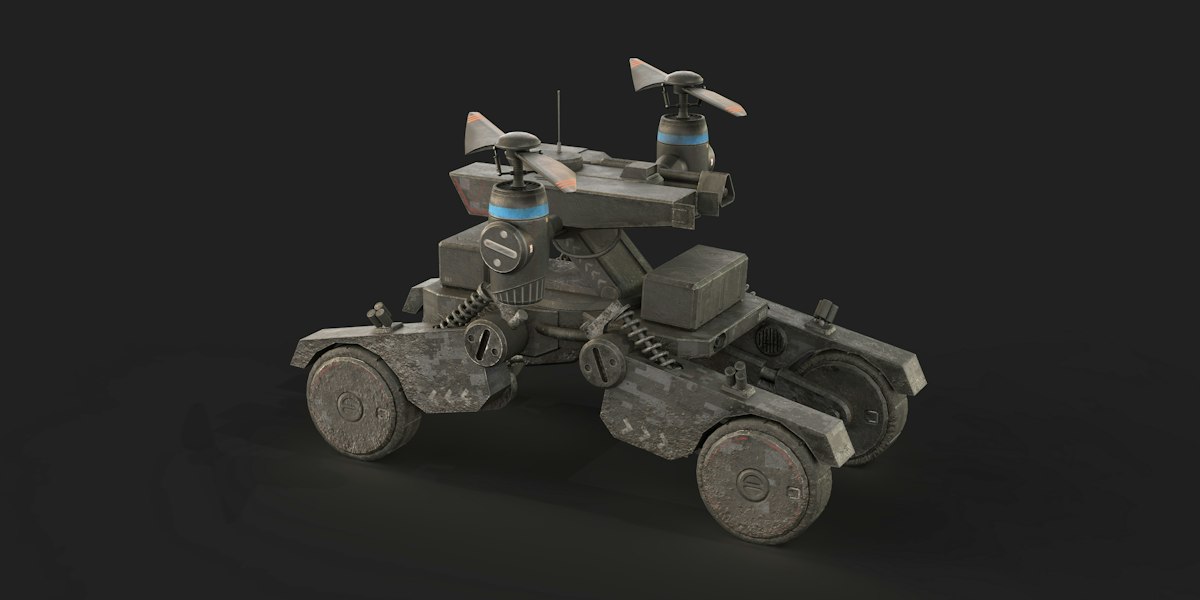
Pioneers in military robotics, like the Ukrainian military, have instead focused their efforts on developing and deploying Unmanned Ground Vehicles (UGVs). These are robotic vehicles that operate on wheels or tracks. Facing the Russian invasion, Ukraine has increasingly relied on ground robots and drone swarms to offset manpower shortages. These UGVs typically handle risky supply runs or medical evacuations. However, they are also being weaponized, equipped with projectile weapons or explosives for direct combat roles.
Ukrainian drones drop robots. Their counteroffensive successes showcase a pragmatic, evolving approach to robotic warfare, deploying these machines behind enemy lines to exploit opportunities with remarkable agility and effectiveness, demonstrating a clear advantage. This reality sharply contrasts with the ambitious, yet seemingly unfunded, aspirations of companies like Foundation Future Industries, which appear to lack concrete implementation. It's a stark difference.
Is Foundation Future Industries a Risky Bet?
Foundation Future Industries faces serious trouble. Missed payroll and financial questions loom large. For developers and prosumers intensely focused on robotics' forward momentum, especially its defense potential, this troubling development is a sobering, unforgettable illustration of inherent difficulties. It demonstrates the considerable gap between ambitious aspirations and tangible, proven results. High valuations and sweeping pronouncements are easily made; meeting payroll obligations and showcasing actual, demonstrable competencies are, however, entirely different matters entirely. It's a harsh reality.
```
Elena Vance reports on artificial intelligence, from frontier research labs to the products reshaping everyday work. She focuses on how machine learning is moving out of the lab and into the real world, and what that shift means for readers.
💬 Comments (0)
No comments yet. Be the first!