Voyager 1 Jupiter Mission Rewrites Outer Planet Science
The Voyager 1 Jupiter mission significantly advanced understanding of Jupiter's dynamic atmosphere and its ring system, pioneering observations that reshaped the scientific view of outer planets.

Voyager 1 Jupiter mission data, collected in 1979, fundamentally reshaped scientific understanding of the outer solar system, revealing a far more dynamic and complex environment than previously theorized. The probe's comprehensive observations provided unprecedented insights into the gas giant's atmosphere and its moons, establishing new paradigms for planetary science and influencing future exploration strategies. This enduring legacy underscores the profound impact of well-executed deep-space missions on scientific discovery and our perception of the cosmos.
Jupiter's Atmosphere Reveals Turbulent Secrets
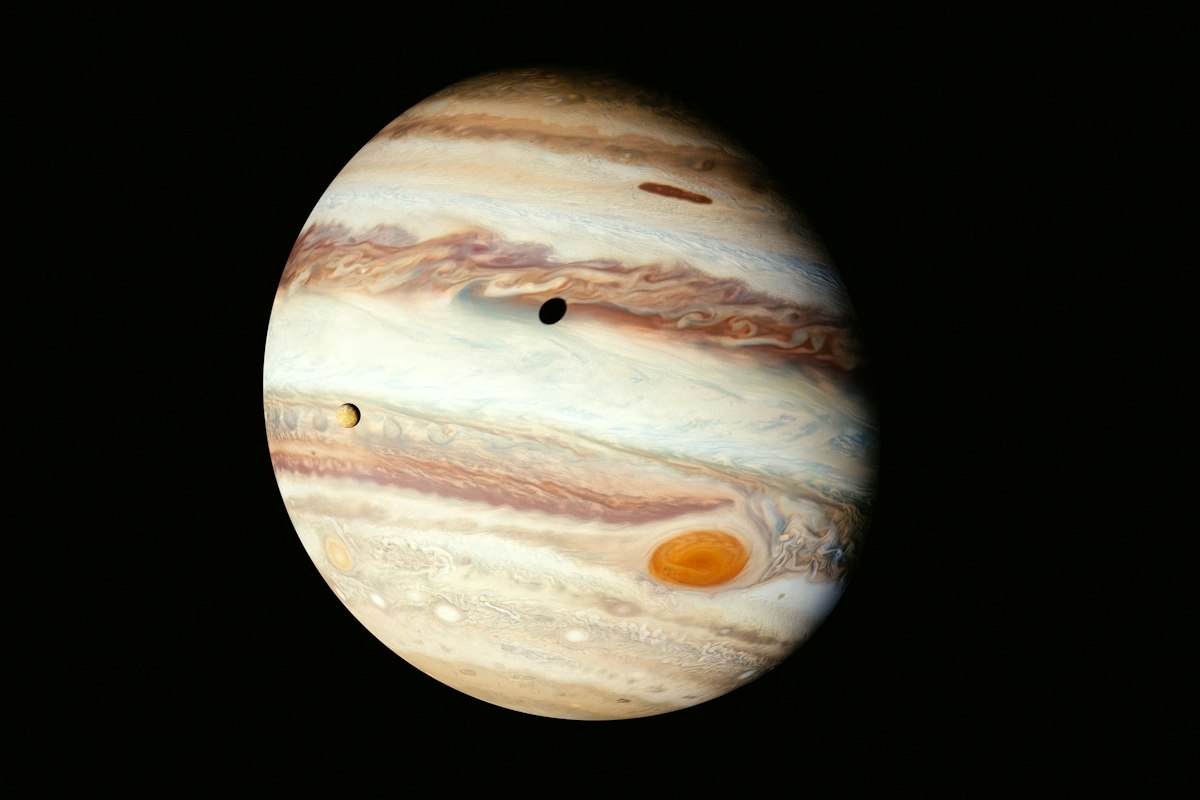
Voyager 1's encounter with Jupiter between January and April 1979 marked a significant leap in our comprehension of planetary atmospheres. The spacecraft captured tens of thousands of images, including a detailed, high-resolution view of the planet's turbulent atmosphere. By snapping photos every 96 seconds, Voyager 1 generated an incredible time-lapse film that depicted discrete atmospheric bands rotating at varying speeds and in opposing directions, akin to a complex, cosmic mechanism in motion. These observations vividly illustrated planet-sized storms swirling and clouds moving rapidly, conveying a sense of a highly energetic and dynamic system. This visual evidence surpassed prior data from NASA's Pioneer 10 and 11 missions, demonstrating that Jupiter's atmosphere was far more active and complex than astronomers had initially believed. The sheer volume and quality of the imagery provided a comprehensive, month-long look at Jupiter's Jovian day, which is approximately 10 Earth hours long, offering a depth of detail that redefined planetary atmospheric studies.
Voyager 1 Finds Jupiter's Hidden Rings
Perhaps one of the most astonishing findings from the Voyager 1 Jupiter mission was the discovery of a faint, thin ring system encircling the planet. This revelation occurred just before the probe's closest approach, when it observed Jupiter backlit by the sun. The rings, primarily composed of dust, were undetectable by Earth-based telescopes prior to Voyager 1's observation. This discovery fundamentally altered the understanding of planetary ring systems. While Voyager 1 identified their existence, subsequent observations by Voyager 2 provided even clearer images of these rings. This breakthrough led to the current understanding that all four outer planets, Jupiter, Saturn, Uranus, and Neptune; possess ring systems. Current scientific hypotheses suggest that Jupiter's dusty rings may be continually replenished by material ejected from volcanic eruptions on its moon, Io, highlighting the interconnectedness of celestial bodies within a planetary system.
Io's Volcanic Activity: A Moon's Dynamic Nature
Further solidifying the significance of the Voyager 1 Jupiter mission, the probe's close pass by the moon Io yielded another groundbreaking discovery: the first observation of a volcanic eruption on a world beyond Earth. This event provided definitive proof that moons, not just planets, could exhibit significant geological activity. The images captured showed a giant volcano spewing material into space, an observation that expanded the scientific perspective on celestial bodies from inert masses to potentially active and evolving worlds. This finding challenged previous assumptions about the geological potential of moons within our solar system and broadened the scope of astrobiological inquiry, suggesting that conditions for geological activity, and perhaps even life, might exist in more diverse locations than previously considered.
The observations taken together showed the largest planet and its moons to be a far more dynamic, complicated and chaotic system than anyone had realized. Moreover, the close-up views of these distant worlds made them more than just dots in the sky. It made them fully realized worlds, places to explore, map and eventually visit.
Strategic Implications for Outer Planet Exploration
The data and discoveries stemming from the Voyager 1 Jupiter mission have had profound strategic implications for the field of outer planet exploration. By demonstrating the immense complexity and dynamic nature of the Jovian system, Voyager 1 validated the necessity of detailed, close-up reconnaissance missions. The identification of Io's volcanic activity and Jupiter's ring system opened up new avenues of scientific inquiry, prompting further investigations into planetary geology, atmospheric dynamics, and the processes that shape planetary environments. This renewed focus on the outer solar system has informed subsequent mission planning, encouraging more ambitious endeavors to study these distant worlds. Indeed, this momentum is reflected in current plans, such as China's announcement to send a lander to Jupiter's moon Callisto, representing the first dedicated landing mission to the Jovian system. The Voyager 1 Jupiter mission's legacy is thus not confined to historical data; it continues to inspire and guide future exploration objectives.
Frequently Asked Questions about the Voyager 1 Jupiter Mission
Here are some common questions regarding the historic Voyager 1 Jupiter mission:
What was the primary objective of the Voyager 1 Jupiter mission?
The main objective of the Voyager 1 Jupiter mission was to conduct detailed studies of Jupiter, its moons, and its magnetic field. It aimed to gather high-resolution images and data to better understand the gas giant's atmosphere, composition, and the dynamics of its surrounding environment, setting the stage for future outer solar system exploration.
What were the most significant discoveries made by the Voyager 1 Jupiter mission?
The Voyager 1 Jupiter mission made several groundbreaking discoveries, including the first detailed observations of Jupiter's turbulent atmosphere, the unexpected discovery of Jupiter's faint ring system, and the first active volcanic eruptions observed on another celestial body, Jupiter's moon Io. These findings fundamentally reshaped planetary science.
How did the Voyager 1 Jupiter mission influence future space exploration?
The Voyager 1 Jupiter mission's discoveries profoundly influenced subsequent space exploration by highlighting the dynamic and complex nature of the outer solar system. It validated the need for close-up reconnaissance missions, inspired further investigations into planetary geology and atmospheric dynamics, and guided the planning of future missions to distant worlds, including those targeting Jupiter's moons.
The Extended Voyage and Future Outlook
Beyond its transformative contributions to our understanding of Jupiter, Voyager 1 continues its historic journey, having officially entered interstellar space in 2012. Although its camera was deactivated in 1990, the probe remains operational with its magnetic field and plasma detectors, the last two of its original science instruments. These instruments are meticulously studying the radiation environment beyond the heliosphere, providing invaluable data on the conditions of interstellar space. Mission scientists anticipate that the probe will exhaust its power supply in the 2030s, marking the end of its active scientific career. However, the knowledge gained from its extended voyage, particularly from the initial Voyager 1 Jupiter mission, has irrevocably altered the trajectory of planetary science, offering a foundation for generations of future research and exploration.

Nadia Petrov covers science and research across disciplines, from the laboratory to the field. She enjoys making discovery accessible and showing why new findings matter.
💬 Comments (0)
No comments yet. Be the first!