Claude Opus 5.5: 40% Cheaper, 30% Faster Than Opus 5
Claude Opus 5.5 delivers Fable 5.1 performance for most work and costs about 40% less to run, Anthropic says, with 20% larger usage limits.
Claude Opus 5.5 Arrives With a Sharper Pitch
Claude Opus 5.5 is here, and Anthropic is making a very specific kind of promise. Less than two months after shipping Claude Opus 5, the company is back with an upgrade that it says delivers Fable 5.1 performance for most work, runs about 40% cheaper, and generates output more than 30% faster than its predecessor. For anyone who has been burning through tokens on agentic coding workflows, that combination is not a minor tweak. It is the difference between a tool you use occasionally and one you leave running all day.
The earlier Opus 5 pitch centered on "near Fable" performance at half the price. Claude Opus 5.5 pushes the same logic further. Anthropic says the new model needs fewer tokens to reach higher quality work, which is the quiet mechanism behind most of the headline numbers. Tokens are priced 20% lower than they were with Opus 5. Fewer tokens consumed, plus a lower per-token cost, compounds into something considerably more attractive than either change would suggest on its own.
What Box and Ramp Are Seeing
Yashodha Bhavnani, VP of AI Products at Box, put the practical case plainly. "Our customers use Box AI on enormous amounts of content, so speed and cost are a top priority," she said. "In our evaluations, Claude Opus 5.5 used a third of the tokens Opus 5 did, and its answers were 40% less verbose without losing accuracy." She expects that to matter most for teams running agents across content in financial services and the public sector, where volume and precision both carry weight.
Over at Ramp, staff software engineer John Ruelas had a more personal frustration to report. Verbose, hard-to-follow output has been his biggest frustration with frontier models, he said, and Claude Opus 5.5 fixes it. It writes like a good colleague. It follows their writing rules. A design spec came out usable with minimal edits, and when it rewrote one of Ramp's prompts, he preferred its version to his own, and when it optimized the company's test suite, he could follow the reasoning and shipped the change with confidence. Those are small claims individually. Together they describe a model that has stopped getting in the way.
More Gas in the Tank for Subscribers
For subscription users, the more tangible change may be the usage math. Anthropic is raising five-hour usage limits by 20%, and because Claude Opus 5.5 costs less to run, both the five-hour and weekly limits stretch further. The two effects stack. A 20% larger bucket paired with a roughly 25% slower burn works out to something close to 50% greater effective run capacity. Anyone on a $20 monthly plan will feel that most.
"Claude Opus 5.5 used among the fewest tokens and steps we measured. In VS Code, it solved more terminal tasks than Opus 5 in less than half the steps." - Mario Rodriguez, chief product officer at GitHub
Mario Rodriguez is GitHub's chief product officer. He framed the coding gains around project scale, not individual tasks. "Developers want agents that can take on real software work and finish it," he said. In testing across GitHub Copilot CLI and VS Code, Claude Opus 5.5 used among the fewest tokens and steps GitHub measured, and in VS Code it solved more terminal tasks than Opus 5 in less than half the steps. So the bigger effect, Rodriguez argued, is that developers' larger projects become more achievable, not just that single tasks get cheaper.
Deloitte's Bug Numbers Are the Sharpest Datapoint
Carl Bennett brought the hardest numbers. He's the CIO at Deloitte Consulting LLP. "Even at its lowest effort setting, Claude Opus 5.5 caught 72% of known bugs in our code reviews to Opus 5's 56% at high effort, with fewer false alarms and a fraction of the output," he said. On US consulting analysis, low-thinking effort matched its higher-thinking settings on half the output and still passed quality checks. That changes staffing. And it's the kind of result that changes how a firm staffs review work, because if the lowest effort setting outperforms the previous model's high effort setting on real bug detection, the cost of catching mistakes drops on both ends, and that's a fact firms can't ignore.

Anthropic Wants to Be a Better Citizen Too
The second half of the announcement is about behavior, not benchmarks. Anthropic points to CEO Dario Amodei's blog post on moderating the pace of AI capability advances, along with a broad program of alignment testing, pre-release evaluation by outside organizations, and safeguards for high-risk areas like cybersecurity and biology. The company calls Claude Opus 5.5 the strongest performing model it has tested to date, with particular improvements on behaviors linked to recent cybersecurity incidents, including biased reasoning and attempts to escape a sandbox.
Where Requests Get Rerouted
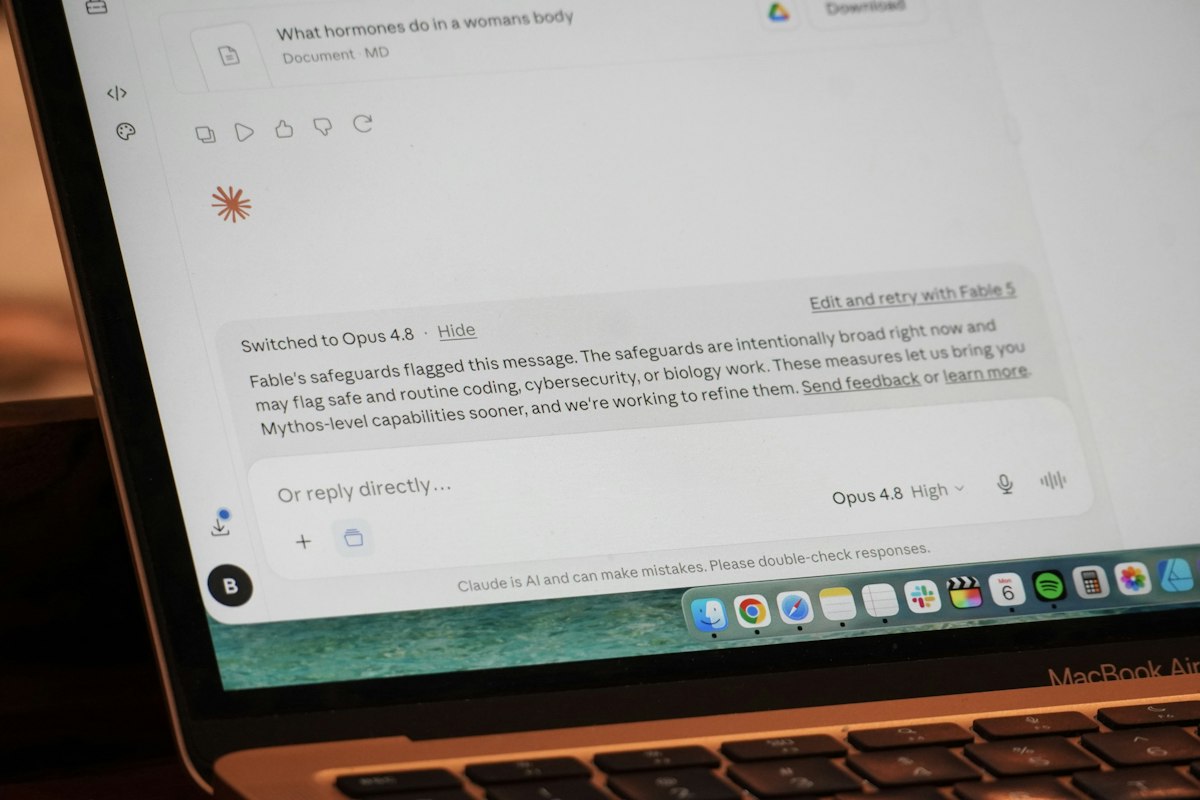
If safeguards trigger, requests fall back from Claude Opus 5.5 to Opus 4.8. In practice, most cybersecurity tasks will be rerouted to Opus 4.8, while biology and LLM development requests go to Opus 5. Anthropic says it applied a similar class of safeguards to Fable 5.1 on cybersecurity, biology, and frontier LLM development. Vetted organizations can now apply to the Life Sciences Verification Program for more powerful access for biological research, and those approved through the Cyber Verification Program will be able to start using Claude Opus 5.5 in a few weeks.
What Comes Next
Claude Opus 5.5 is available today. Anthropic says Claude Sonnet 5.5 and Haiku 5.5 will follow over the coming weeks, which puts the rest of the Claude lineup on the same refresh cycle.
- Token pricing is 20% lower than with Opus 5
- Output generation is more than 30% faster than Opus 5
- Five-hour usage limits rise by 20% for subscribers
- Effective run capacity increases by roughly 50% when the larger limit and slower burn combine
For developers and teams already deep in agentic workflows, the case for moving up from Opus 5 to Claude Opus 5.5 rests on a simple calculation. Cheaper tokens, fewer of them needed, faster output, and more room before you hit a ceiling. That is a lot of ground covered in under two months.
Frequently Asked Questions
What performance and cost improvements does Claude Opus 5.5 offer compared to Opus 5?
Anthropic says Claude Opus 5.5 delivers Fable 5.1 performance for most work, runs about 40% cheaper, and generates output more than 30% faster than its predecessor. Tokens are priced 20% lower than they were with Opus 5, and the new model needs fewer tokens to reach higher quality work.
How does Claude Opus 5.5 affect subscription usage limits and effective run capacity?
Anthropic is raising five-hour usage limits by 20%, and because Claude Opus 5.5 costs less to run, both the five-hour and weekly limits stretch further. A 20% larger bucket paired with a roughly 25% slower burn works out to something close to 50% greater effective run capacity, which anyone on a $20 monthly plan will feel most.
What did Deloitte's CIO report about Claude Opus 5.5's bug detection performance?
Carl Bennett, CIO at Deloitte Consulting LLP, said that even at its lowest effort setting, Claude Opus 5.5 caught 72% of known bugs in their code reviews to Opus 5's 56% at high effort, with fewer false alarms and a fraction of the output. He also noted that on US consulting analysis, low-thinking effort matched its higher-thinking settings on half the output and still passed quality checks.
What happens when safeguards trigger on Claude Opus 5.5 requests, and which models handle rerouted tasks?
If safeguards trigger, requests fall back from Claude Opus 5.5 to Opus 4.8. In practice, most cybersecurity tasks will be rerouted to Opus 4.8, while biology and LLM development requests go to Opus 5.
What did Box and Ramp representatives observe about Claude Opus 5.5's output quality and token usage?
Yashodha Bhavnani, VP of AI Products at Box, said that in their evaluations Claude Opus 5.5 used a third of the tokens Opus 5 did, and its answers were 40% less verbose without losing accuracy. John Ruelas, staff software engineer at Ramp, said Claude Opus 5.5 fixes verbose, hard-to-follow output, writes like a good colleague, follows their writing rules, and produced a usable design spec with minimal edits.

Julian Sterling reports on enterprise IT, data infrastructure and the vendors that keep modern business running. He has a long-standing interest in how organisations modernise their systems without breaking what already works.
💬 Comments (0)
No comments yet. Be the first!